Safe Staffing Ratios

NNU’s proposal for minimum, mandated, nurse-to-patient staffing ratios protect our patients’ right to nursing care. We know that every patient deserves a single standard of high-quality care. Safe staffing ratios, coupled with nurses’ powerful voice of advocacy secured in collective bargaining, protect our patients from complications that arise from missed care such as medical errors, health care disparities, infections, and so much more. Read more »

Nurse Staffing Standards for Hospital Patient Safety and Quality Care Act fact sheet
Read our fact sheet on legislation that would protect patients and improve health care by setting mandated, minimum, registered nurse-to-patient staffing ratios.

There is No Nurse Shortage
There is a nurse retention crisis due to the hospital industry’s systematic failure to invest in safe, quality, human-to-human patient care. Hospital management has created a staffing crisis.
About safe staffing ratios

The science of ratios
Decades of studies have shown that more nurses equate to lives saved and fewer complications. Researchers have been focusing on what exactly is the mediating link between increasing RN staffing and improved outcomes.
Learning from the California experience
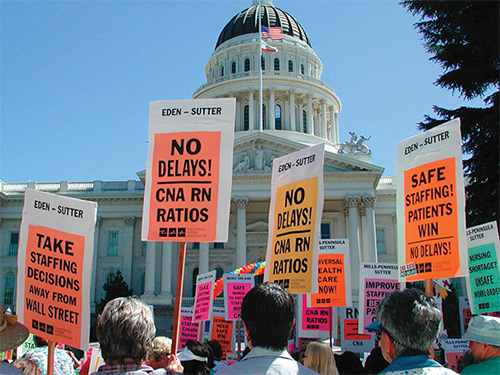
In 1999, the registered nurses of the California Nurses Association successfully sponsored and lobbied the California Legislature to pass A.B. 394, the historic bill that made minimum, specific numerical staffing ratios the golden standard in the Golden State.

What does the California ratios law actually require?
The CNA-sponsored safe staffing law has multiple provisions designed to remedy unsafe staffing in acute-care facilities. California’s safe staffing standards are based on individual patient acuity, of which the RN ratios is the minimum.

We need your help to get the Nurse Staffing Standards for Hospital Patient Safety and Quality Care Act passed to improve working conditions for nurses and to protect patients. Take action by urging your elected officials to support this critical legislation.
Reports

Protecting Our Front Line: Ending the Shortage of Good Nursing Jobs and the Industry-created Unsafe Staffing Crisis
In this report, National Nurses United describes how the hospital industry has driven registered nurses from the bedside.

RN Staffing Ratios: A Necessary Solution to the Patient Safety Crisis in U.S. Hospitals
NNU stands ready to help you bring ratios to your state. Read our booklet to learn more.
RN Staffing Ratios Whitepaper
Registered nurse staffing levels that facilitate safe, competent, therapeutic, and effective care are vital to the safety of patients in U.S. hospitals. Research reveals that these ratios are associated with lower mortality, lower nurse burnout, and better nurse retention.
Videos
Safe staffing ratios protect patients and nurses
Safe RN ratios have been proven to improve the quality of care and nurse recruitment and retention in California hospitals.
California and beyond
California is the only state in the country that puts a legal limit on the number of patients a nurse can be made to care for at one time. National Nurses United fights for safe staffing ratios in our union contracts and for federal legislation for safe staffing ratios.
Articles



Press releases