


Press Release
NNU report finds a majority of nurses experienced workplace violence in the past year
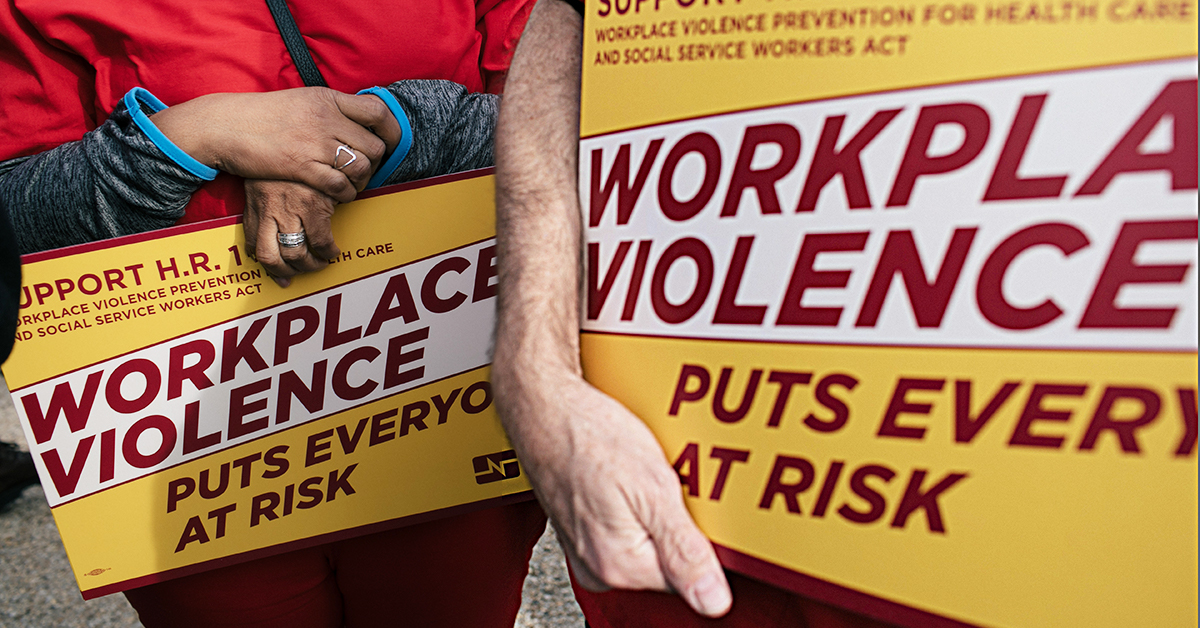
Nearly 85 percent of nurses have experienced at least one type of workplace violence, with more than one-third seeing an increase in the past year
Health care workers have been experiencing a surge in workplace violence rates nationally since the onset of the Covid-19 pandemic, building on already rising rates in previous years. A nationwide survey conducted by National Nurses United (NNU), the nation’s largest union and professional association of registered nurses, found that the majority of nurses have experienced workplace violence and nearly one-third have seen a rise in rates in the past year.
NNU’s report, The State of Workplace Violence in Health Care in 2025-2026, released today, analyzes new survey data, collected from 1,267 RNs working in 28 states and D.C. between July 2025 and May 2026, regarding nurses’ recent experiences of workplace violence. The results of NNU’s workplace violence survey confirm that workplace violence continues to be a serious hazard impacting a majority of the nation’s nurses and patients, underlining the need for additional action to protect nurses, other health care workers, and their patients.
NNU’s major findings on workplace violence include:
- A large majority of nurses (84.8 percent) report experiencing at least one type of workplace violence in the past year.
- More than one-third of RNs (36.4 percent) report an increase in workplace violence on their unit in the previous year. In contrast, only 6.8 percent of nurses report that workplace violence has decreased on their unit in the previous year.
- 1 in 10 nurses (70.3 percent) report having been verbally threatened in the previous year.
- To read the full report, including statistics and sources, go here.
Safe staffing is essential to workplace violence prevention.
Only about one-third of nurses (35.5 percent) report that staff are available at all times to respond to violence incidents, and less than 3 in 10 nurses (28.5 percent) report that additional staff are placed to reduce the risk of violence. This is concerning given that workplace violence is significantly more likely to occur when nurses are short staffed, according to research cited in NNU’s 2024 workplace violence prevention fact sheet.
When employers fail to safely staff units, it increases the risk of workplace violence due to increased wait times, unmet patient needs, and increased stress and moral distress of health care staff. In NNU’s surveys and focus groups, nurses regularly noted the role that short staffing plays in increasing the risk of workplace violence.
Employers fail to implement proven measures to prevent workplace violence
Employers continue to fail to address workplace violence hazards in health care facilities across the nation. NNU’s survey found that very few employers have implemented essential, proven workplace violence prevention measures. Only 40.2 percent of nurses report their facility uses a chart or room-flagging system to indicate patients at increased risk of violence and a mere 17.0 percent use metal detectors to prevent weapons from entering the facility.
Only 18.2 percent of nurses report that their employer includes nurses and other employees in violence risk assessments — an element that has been shown by scientific research to be vital to effective workplace violence prevention plans. Only about 4 in 10 nurses (38.4 percent) report that their employer provides a clear way to report incidents.
NNU strongly supports a comprehensive workplace violence prevention standard.
The Workplace Violence Prevention for Health Care and Social Service Workers Act (S. 1232/H.R. 2531) is aimed at protecting nurses, other health care workers, and their patients from workplace violence. These federal bills would mandate that federal OSHA create a standard that would require health care and social service employers to create, implement, and maintain effective workplace violence prevention plans. Under S. 1232/H.R. 2531, such a standard would include all the elements that effectively protect nurses and other health care workers.
To read the full report, including statistics and sources, go here.
National Nurses United is the largest and fastest-growing union and professional association of registered nurses in the United States with more than 225,000 members nationwide. NNU affiliates include California Nurses Association/National Nurses Organizing Committee, DC Nurses Association, Michigan Nurses Association, Minnesota Nurses Association, and New York State Nurses Association.