


The State of Workplace Violence in Health Care in 2025-2026
Nurses Report Increasing Workplace Violence Rates, Failure of Employers to Implement Proven Prevention Measures
Health care workers have been experiencing a surge in workplace violence rates nationally since the onset of the Covid-19 pandemic, building on already rising rates in previous years. National Nurses United (NNU), the largest labor union for registered nurses (RNs) in the United States, regularly surveys nurses — both union members and nonmembers — regarding health and safety conditions in their workplaces. This report analyzes new survey data, collected from 1,267 RNs working in 28 states and D.C. between July 2025 and May 2026, regarding nurses’ recent experiences of workplace violence.1 The results of NNU’s 2025–26 Workplace Violence Survey confirm that workplace violence continues to be a serious hazard impacting a majority of the nation’s nurses and patients, underlining the need for additional action to protect nurses, other health care workers, and their patients.
NNU strongly supports a comprehensive workplace violence prevention standard.
The Workplace Violence Prevention for Health Care and Social Service Workers Act (S. 1232/H.R. 2531) is aimed at protecting nurses, other health care workers, and their patients from workplace violence. These federal bills would mandate that federal OSHA create a standard that would require health care and social service employers to create, implement, and maintain effective workplace violence prevention plans. Under S. 1232/H.R. 2531, such a standard would include all the elements that effectively protect nurses and other health care workers.
RNs Report High and Increasing Rates of Workplace Violence
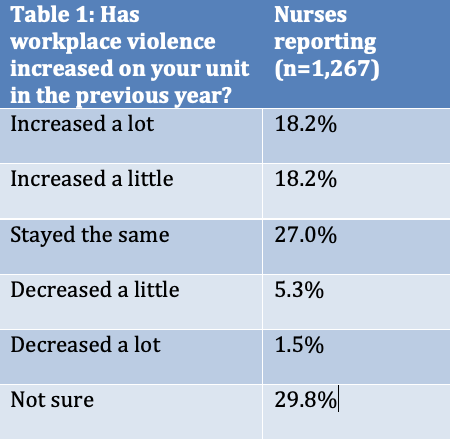
Over one-third of RNs (36.4 percent) report an increase in workplace violence on their unit in the previous year. In contrast, only 6.8 percent of nurses report that workplace violence has decreased on their unit in the previous year.
When asked what contributes to workplace violence in their units, nurses shared similar concerns, including short staffing, inadequate security, and a lack of support from management, as well as the current sociopolitical landscape. Specifically, nurses shared:
- “Short staffing, delays in care or brevity of care (nurse can't stay to do all the things a patient/family wants or needs) causing frustration leading to violence. Also patient/family frustration with health care system: unable to get appointments, navigating the system, denial of coverage/treatment, etc.”
- “The decrease [in workplace violence] is always when we have staffing available, especially with sitter cases. If we can get a sitter, patients improve significantly.”
- “Lack of staff, lack of concern by the hospital… security is a joke! I was just recently assaulted and it all could have been prevented…”
- “I think the lack of access to mental health and people under tremendous amount of stress due to lack of finances, political, environmental, work is the reason why there has been an increase in workplace violence.”
- “Polarized political landscape and increased call for violence from current administration, meth, poor economy, short staffing, higher acuity.”
Types of Workplace Violence Experienced by Nurses in the Past Year
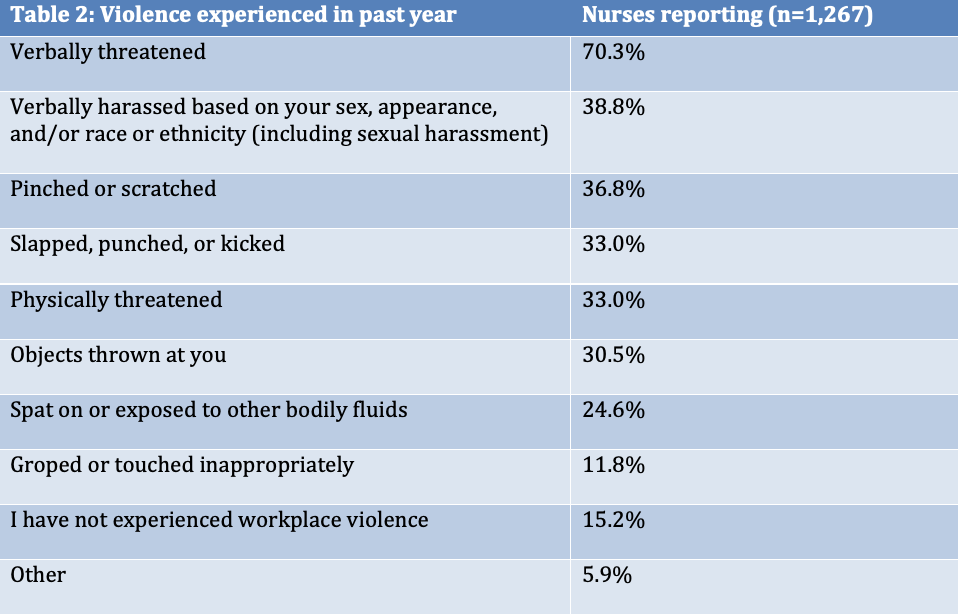
A majority of nurses (84.8 percent) report experiencing at least one type of workplace violence in the past year. Seven in 10 nurses (70.3 percent) report having been verbally threatened in the previous year. Nurses report frequent occurrences of physical violence, including being pinched, scratched, slapped, punched, kicked, and having objects thrown.
In the surveys, RNs shared descriptions of their experiences with workplace violence, including:
- “A dangerous, undermedicated patient attacked me and with his fingernail tore a 1.5 in plug from my forearm. The tissue was never found, and it is presumed that he ate it. I received first aid. I have a noticeable scar. The hospital manager told me, ‘You knew the job was dangerous when you took it.’”
- “I was chased out of a room by an ETOH/psych patient who ran after me down the hall, cornered me, and punched my stomach and head before running to the front nursing station where they jumped behind the desk and tried to attack 3 nurses there. A Code Grey was called and the patient required 4-point restraints and a 24/7 security guard stationed at their door.”
- “In the NICU, there was an irate dad screaming at me and our coordinator. Yelling that he was going to kill us because he didn't like our policies…”
- “One time a patient grabbed my stethoscope around my neck and tried to choke me then he started swinging it at me.”
Impacts of Workplace Violence on Nurses
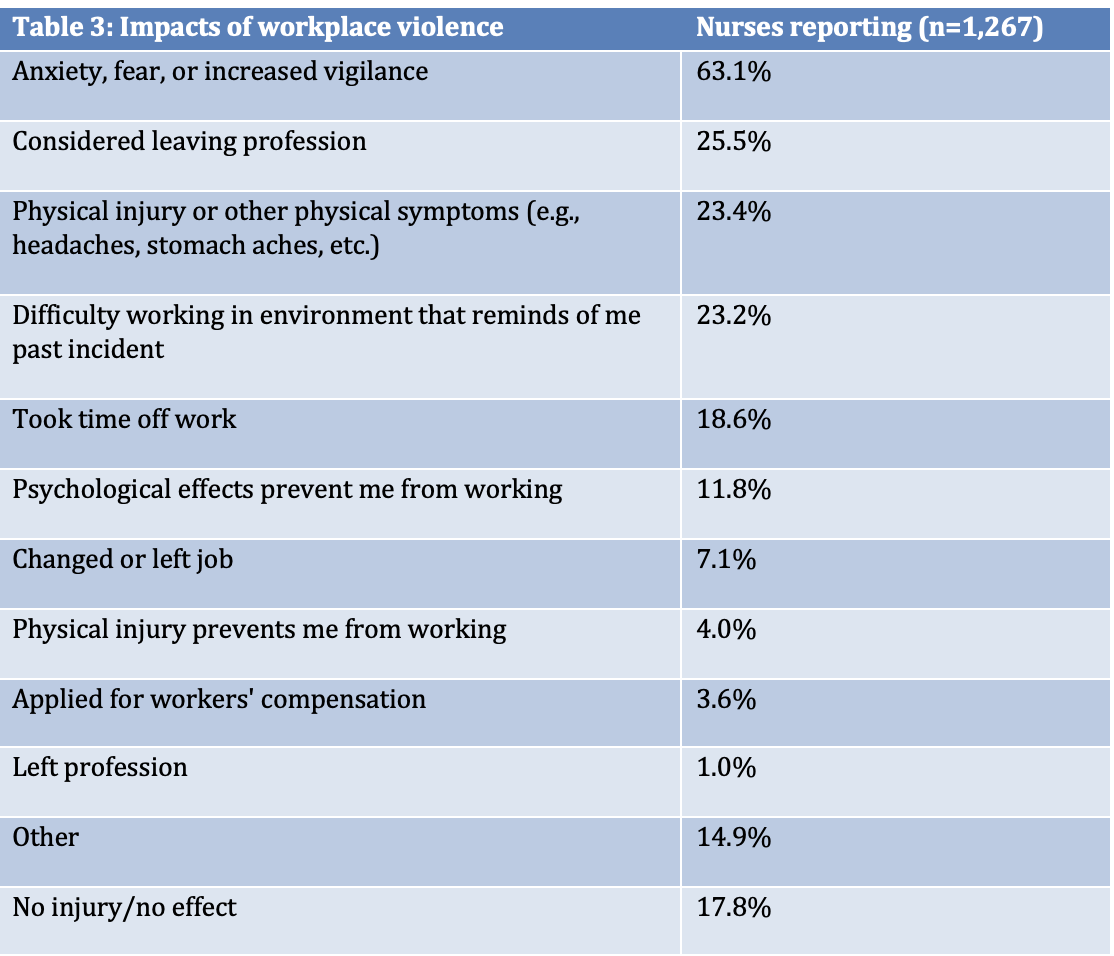
Workplace violence can result in physical injuries, including broken bones, contusions, and even death. In our survey, almost one-quarter of nurses (23.4 percent) report experiencing a physical injury or other physical symptoms related to workplace violence incidents.
Workplace violence can also result in nonphysical impacts that have serious and long-lasting impacts on nurses. A majority of nurses (63.1 percent) report experiencing anxiety, fear, or increased vigilance due to workplace violence, and almost one-quarter (23.2 percent) report having difficulty working in an environment that reminds them of a past incident. Strikingly, over 1 in 10 nurses (11.8 percent) report that psychological impacts of workplace violence prevented them from working.
Experiencing workplace violence and lack of employer prevention plans can also lead to nurses taking time off work or leaving their jobs. In our survey, 1 in 4 nurses (25.5 percent) considered leaving the profession due to workplace violence and almost 1 in 5 nurses (18.6 percent) report taking time off work after a workplace violence incident.
Employer Responses to Workplace Violence Incidents
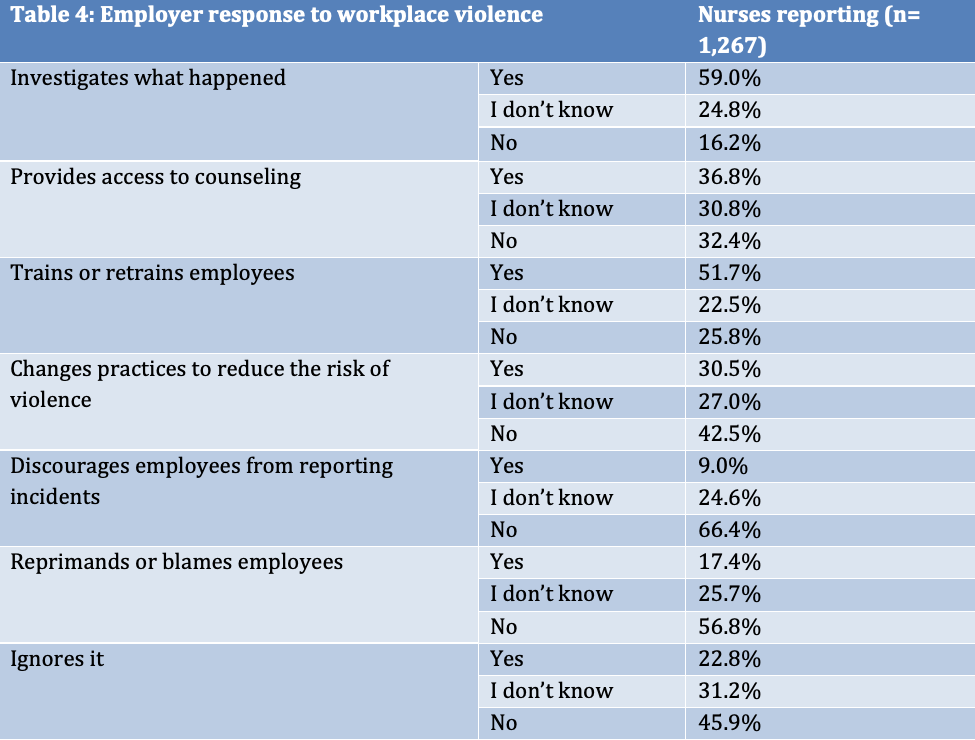
Health care employers often fail to effectively respond to nurses’ reports of workplace violence incidents. Nearly half of nurses (42.5 percent) report that their employer does not change practices to reduce the risk of violence, and over 1 in 5 nurses (22.8) report that their employer ignores nurses’ reports of workplace violence incidents.
When health care employers do respond to violent incidents, their responses are often unhelpful or ineffective. Our survey found that only 6 in 10 nurses (59.0 percent) report that their employer investigates what happened after a workplace violence incident. About 1 in 6 nurses (17.4 percent) even report that they are reprimanded or blamed when they report a violent incident — a ineffective response that can cause further harm to RNs.
Prevention Measures Implemented by Employers
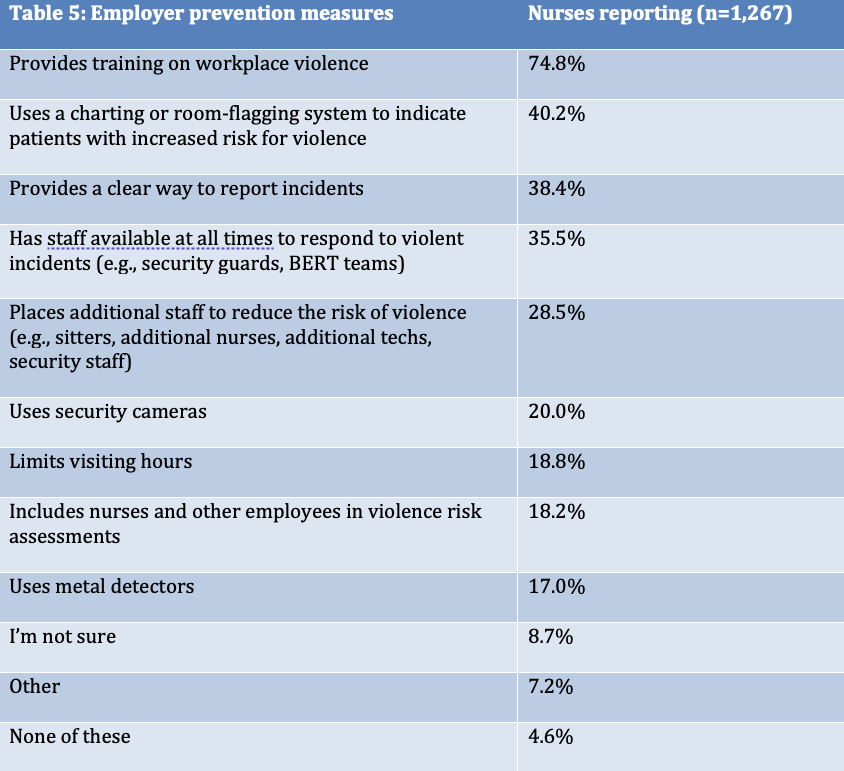
Employers continue to fail to address workplace violence hazards in health care facilities across the nation. NNU’s survey found that very few employers have implemented the most basic of workplace violence prevention measures. While almost three-quarters of nurses (74.8 percent) report their employer provides training on workplace violence, other prevention measures are reported significantly less.
Only about one-third of nurses (35.5 percent) report that staff are available at all times to respond to violence incidents, and less than 3 in 10 nurses (28.5 percent) report that additional staff are placed to reduce the risk of violence. This is concerning given that workplace violence is significantly more likely to occur when nurses are short staffed.2
Only 18.2 percent of nurses report that their employer includes nurses and other employees in violence risk assessments — an element that has been shown by scientific research to be vital to effective workplace violence prevention plans.3 Only about 4 in 10 nurses (38.4 percent) report that their employer provides a clear way to report incidents.
Types of Health Care Facilities Respondents Work In
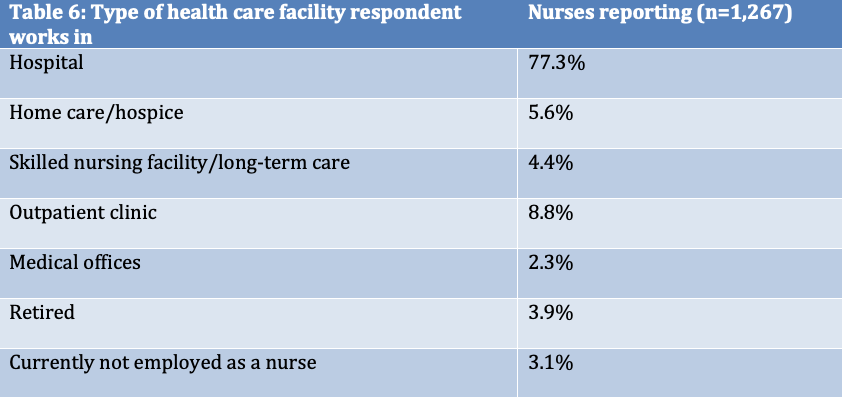
The majority of nurses who responded to NNU’s 2025–2026 Workplace Violence Survey work in hospitals. Nurse respondents also work in home care/hospice, skilled nursing facilities/long-term care, outpatient clinics, and medical offices.
1RN respondents work in the following states: Arizona, California, Colorado, DC, Florida, Georgia, Illinois, Indiana, Kansas, Louisiana, Maine, Maryland, Massachusetts, Michigan, Minnesota, Missouri, Nevada, New Hampshire, New Jersey, New York, North Carolina, Ohio, Oklahoma, West Virginia, Tennessee, Texas, Washington, Wisconsin, and Virginia.
2See research in National Nurses United, “Workplace violence prevention: Safe staffing is a key measure,” June 2024.
3Arnetz, J.E., L. Hamblin, et al., “Preventing Patient-to-Worker Violence in Hospitals: Outcome of a Randomized Controlled Intervention,” Journal of Occupational and Environmental Medicine, 2017, 59(1): 18-27.
Lanza M., J. Rierdan, et al. “Reducing Violence Against Nurses: The Violence Prevention Community Meeting,” Issues in Mental Health Nursing, 2009, 30(12): 745-50.
See more research in National Nurses United, “Injury to None: Preventing Workplace Violence to Protect Health Care Workers and Their Patients,” Feb 2021.