


Press Release
New data shows there is a nurse retention crisis, not a nurse shortage
1.15 million have RN licenses but are not working as RNs
Nearly 1.15 million registered nurses (RNs) with active licenses are not working as nurses, announced National Nurses United (NNU), the nation’s largest union of registered nurses. NNU reached this number by comparing the latest Bureau of Labor Statistics data, released on May 15, with data covering the same period from the National Council of the State Boards of Nursing (NCSBN).
In the fact sheet “There Is No Nurse Shortage”, NNU argues that, to solve the immense and mounting challenges facing the nursing profession, employers and lawmakers must focus on recruiting and retaining these 1.15 million nurses back into the hospital and the profession.
Download PDF of our fact sheet
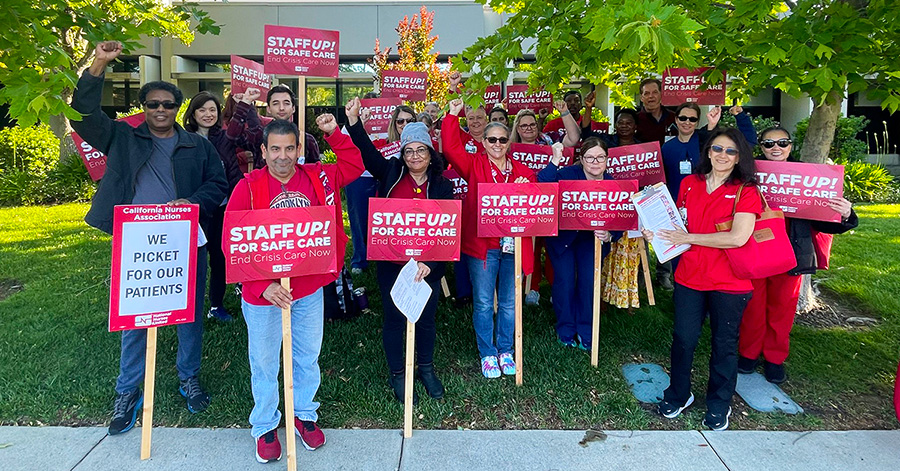
“The data is clear that the U.S. nursing profession has a retention crisis, not a nurse shortage,” said NNU President Jamie Brown, RN. “We want the public to know that our working conditions are so unsafe and unsustainable that they are driving new and experienced nurses away from hospitals, both large and small. Hospital employers have the power to immediately address the retention crisis by taking concrete steps to improve patient care conditions, including improving RN-to-patient ratios and providing appropriate support to caregivers.”
In addition to the lived experiences of RNs across the country, data analyzed and published in peer-reviewed medical journals over the past few years show a systematic failure to invest in safe, quality, human-to-human patient care.
- A May 2026 study on hospital nursing published in Medical Care, a journal of the American Public Health Association, found that nursing has not returned to pre-Covid conditions – and that, in some cases, are “even worse than they were at the height of the pandemic.”
- A February 2026 analysis of survey data, published by the peer-reviewed JAMA Network, found that adequate staffing is the top factor that would increase RNs’ likelihood of returning to employment.
- A February 2024 NNU report found that employers’ failures to prevent workplace violence – which includes improving staffing – drove more than a third of nurses to consider leaving their job and nearly 20 percent to change or leave their job.
Brown continued: “It’s not uncommon for nurses to experience the never-ending cycle of training a new nurse, only for them to leave after six months because of the intolerable conditions. Then, they have to repeat the process, while still managing a full patient load, until they can’t take it anymore and leave as well. It’s also not uncommon for nurses with less than a year of experience to take on the role of preceptor, or trainer, because experienced nurses are leaving the profession. That’s unacceptable and needs to be solved.”
NNU advocates for RN-to-patient ratios, which save patient lives and increase nurse retention, as reported in countless academic studies published in peer-reviewed medical journals.
A federal bill, the Nurse Staffing Standards for Hospital Patient Safety and Quality Care Act (S. 1709, H.R. 3415) was introduced in Congress in 2025. It is modeled after the nurse-to-patient ratio legislation in California, which, more than two decades ago, became the first state to require such minimum standards hospital-wide and remains the only state that requires them in every hospital unit. Study after study has found that the law has improved nurse satisfaction and patient outcomes.
More information can be found in the NNU fact sheet: “There is No Nurse Shortage.”
National Nurses United is the largest and fastest-growing union and professional association of registered nurses in the United States with more than 225,000 members nationwide. NNU affiliates include California Nurses Association/National Nurses Organizing Committee, DC Nurses Association, Michigan Nurses Association, Minnesota Nurses Association, and New York State Nurses Association.