


Ebola virus disease: What nurses need to know
What is Ebola virus disease?
Ebola virus disease is a rare but deadly illness in humans with an average case fatality rate around 50 percent (range 20 to 90 percent). Ebola virus circulates in animal reservoirs and can spillover into human populations through close contact with blood or other bodily fluids of infected animals.
Ebola virus disease is caused by viruses that belong to the Orthoebolavirus genus. Three species of Orthoebolaviruses are known to cause outbreaks in humans:
- Ebola virus, which has been responsible for several outbreaks including the largest on record (the deadly 2014-16 outbreak in West Africa).
- Sudan virus, which has caused several smaller outbreaks.
- Bundibugyo virus, which is the most recently discovered type of Orthoebolavirus and has been associated with a few outbreaks, including the current 2026 outbreak in the Democratic Republic of the Congo (DRC).
All three of these Orthoebolaviruses can cause viral hemorrhagic fever in humans.
What are the symptoms of Ebola virus disease?
Ebola virus disease is characterized by acute hemorrhagic fever. Initial symptoms are “flu-like,” including fever, aches and pains, headache, weakness and fatigue, and sore throat (sometimes referred to as “dry” symptoms). After a few days, patients can become sicker, experiencing additional symptoms including loss of appetite, life-threatening bleeding, nausea, abdominal pain, diarrhea, and vomiting (“wet” symptoms).
How is Ebola virus transmitted?
Transmission routes
Ebola virus has been isolated from many different bodily fluids, including blood, saliva, urine, semen, breast milk, conjunctiva (tears), stool, vaginal fluid, sweat, amniotic fluid, aqueous humor, cerebrospinal fluid, and others, even months after recovery. Patients infected with Ebola virus typically lose three to five liters of bodily fluids daily, up to 10 liters per day.
Transmission occurs through contact with the blood or other bodily fluids from an infected person or animal. The infectious dose is extremely low, requiring less than 10 viral particles to cause infection. Contact can occur via multiple pathways:
- Direct contact with infectious blood or other bodily fluids—when blood or other bodily fluid enters the body through broken skin or a mucus membrane.
- Indirect contact with infectious blood or other bodily fluids—when a surface is contaminated with blood or other bodily fluids and then is transferred by the hands to the mouth, nose, or eyes.
- Inhalation of infectious aerosols—infectious aerosols are generated when a patient with Ebola coughs, vomits, has diarrhea or hemorrhage, or has certain aerosol-generating medical procedures performed. Those aerosols can remain aloft in the air and can result in infection if inhaled.
Research indicates that routes of entry can include mucosal, oral, and sexual transmission. Recent work indicates that systemic infection can occur via exposure through abraded skin in non-human primates.
Incubation and infectious period
The incubation period for Ebola virus ranges from two to 21 days, with an average of six days. A literature review reported a mean infectious period of nine days for survivors and a mean time from onset of wet symptoms to death of five days. However, additional research has shown that Ebola virus can persist in different tissues for days to months after recovery, including in semen (up to 18 months after recovery), aqueous humor (63 days), urine (26 days), and breast milk (15 days), presenting long-term transmission risk for survivors.
What infection prevention and control measures are important to protect nurses and prevent Ebola virus spread in health care facilities?
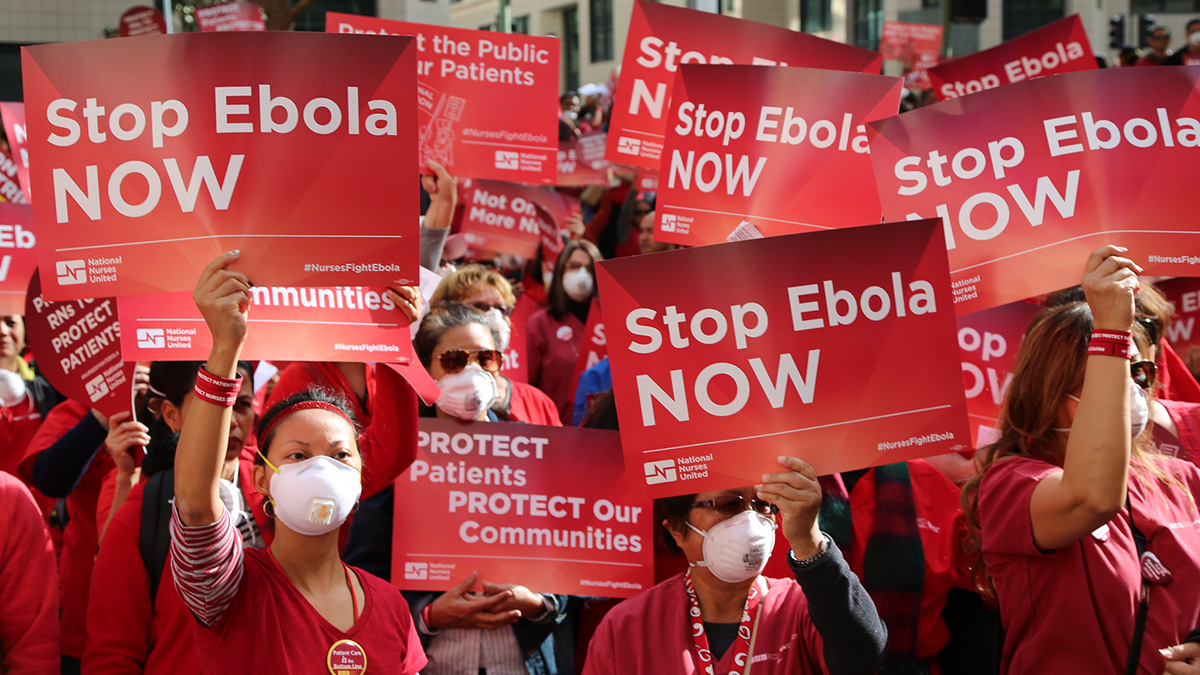
Health care employers are responsible for providing a safe work and patient care environment. When it comes to Ebola virus, preparedness is essential. In 2015, when a traveler sought care at their hospital, two nurses became infected with Ebola because the hospital was unprepared and failed to provide nurses with the proper PPE, training, and other protections.
NNU’s Demands for Ebola Preparedness
- Screening—screen patients for Ebola-like illness who may have related travel or exposure history.
- Isolation—patients with suspected or confirmed Ebola should be isolated immediately in an airborne infection isolation room (AIIR). The AIIR should have an antechamber or dedicated space for PPE donning and doffing.
- Personal protective equipment—PPE must be donned for care of any suspected or confirmed Ebola patient, regardless of phase of symptoms:
- Full-body hazmat suits that leave no skin exposed or unprotected and have integrated undersocks or underboots.
- NIOSH-approved powered air purifying respirators (PAPRs) with HEPA filters, full cowl or hood with an integrated face shield that covers all areas of the face, head, neck, and upper torso, with an assigned protection factor of at least 50.
- Impermeable boots or coverings for the feet and lower legs must be used and must not create a slipping hazard.
- Single-use (disposable) apron as needed based on the independent professional judgment of the direct care RN assigned to the patient
- All PPE must meet or exceed ASTM standard F1670 for blood penetration and ASTM 1671 for viral penetration, including all seams, zippers, and other fastenings or closures.
- Exposure notification and contact tracing—Employers should conduct contact tracing and immediately notify staff who were potentially exposed. Testing should be available at no cost to any employee who believes they may have been exposed to Ebola.
- Paid precautionary medical removal—Employers should provide paid precautionary medical removal for any health care worker who is removed from the workplace due to occupational exposure to or infection with Ebola.
- Training—training and education should be provided to RNs about Ebola, how to recognize signs and symptoms, and infection control protocols, including continuous interactive training for RNs who are exposed to patients or their bodily fluids.
Here are NNU’s full Ebola-related bargaining demands.
California’s Ebola Standard
In 2014, California Nurses Association/National Nurses United (CNA/NNU) won an enforceable Ebola safety standard under Cal/OSHA, which requires employers to follow optimal standards—unlike the unenforceable guidelines from the CDC. Some key highlights:
- For any nurse in direct contact with a suspected or confirmed Ebola patient, hospitals must provide: PAPRs with a full hood or cowl, full-body suits, nitrile gloves, non-slip cover boots
- All PPE must meet or exceed ASTM standards on blood and bloodborne pathogen penetration.
- Continuous, hands-on training is required for nurses and other health care workers before treating any suspected or confirmed Ebola patient.
- Hospitals must actively involve nurses in the development of the exposure control plan.
- Right to express health and safety concerns without fear of retaliation.
- Nurses exposed to potential infection may be relieved of work duties or placed in alternate job, but otherwise must receive full pay and preserve all benefits until the incubation period ends and they are returned to their original position.
For more about Cal/OSHA’s Ebola safety standard, visit: https://www.nationalnursesunited.org/blog/ebola-preparedness-what-national-nurses-united-won-california
CDC downgraded their Ebola guidance
In 2022, CDC updated its infection prevention and control guidance for Ebola to emphasize a misleading distinction between “dry” and “wet” symptoms. CDC’s guidance proscribes a two-tier system of protection, where health care workers are instructed to wear lesser PPE when Ebola-infected cases have “dry” symptoms (fluid-resistant gown or coveralls, full face shield, facemask, double gloves) and to only step up PPE once patients begin to experience “wet” symptoms (impermeable gown or coveralls, PAPR or N95, double gloves, disposable boot covers, and disposable apron). There are several issues with the CDC’s approach (for more details, read CNA’s letter):
- The transition from dry to wet symptoms is not standardized or predictable and can occur in a very short period, leaving health care workers unprotected under the CDC’s two-tier approach.
- Patients with “dry” symptoms can also transmit the virus. One outbreak investigation found one-third of households of patients with “dry” symptoms had onward transmission.
- Aerosol transmission is possible at any point in the clinical course. Ebola virus can be aerosolized via aerosol-generating medical procedures, cleaning tasks, doffing contaminated PPE, flushing toilets, and patients’ respiratory and gastrointestinal events (virus detected in respiratory tract even prior to “wet” symptom onset).
- Infection can occur with 10 or fewer viral particles, making even trace amounts of exposure potentially deadly.
- Removing respirators and leaving skin or clothing exposed can lead to unprotected exposures.
Read more about NNU’s advocacy for the most protective Ebola safety standards for RNs and patients here: https://www.nationalnursesunited.org/ebola