


When Home is Not Safe

Trump’s cruel and racist immigration policies are endangering nurse members and upending lives, careers
By Lucia Hwang with reporting by Pauline Luppert
National Nurse magazine - July | Aug | Sept 2026 Issue
Since the Trump administration began targeting immigrants and Black and brown people for deportation, nurses have long been concerned about how these actions hurt patients — whether it’s federal agents using excessive force on people they are trying to detain or even killing them, showing up at hospitals with detainees needing medical attention and putting the entire facility in a panic, or instilling so much fear in our communities that people just stop seeking medical care because they can’t go outside.
But what happens when the nurse is the one at risk of deportation, the one hunted by Trump’s cruel and racist deportation machine? That’s exactly the situation that some of our union nurse members are in.
In the following pages, we share the stories of three categories of immigrant nurses who have been directly harmed by the Trump administration: Dreamer or DACA, deferred action for childhood arrival, nurses; nurses seeking asylum; and nurses with temporary protected status (TPS). For years, even decades, they have all been legally permitted to live and work in the United States, until Trump and the U.S. Supreme Court suddenly decided for some of them that they are not. Now they are in danger of arrest and detainment in one of the many for-profit detention prisons that have been documented to provide horrific living conditions, or deportation to their country of origin or even a third country.
For nurses who have built entire lives, friend networks, and families here, who have successfully pursued nursing careers here and even taken leadership positions with our union, the current deportation risks they face are devastating and earth shattering. They are saving lives each day, but their own lives are now hanging in the balance.
But as you can also learn from their stories, we, as the largest nursing union in the country, have the power to help. We are one of the only national unions to call for abolishing ICE. And by fighting collectively and marshalling our members, our resources, our knowledge, and our reputation as the most trusted profession in the United States, we have been able to prevent the worst for some of our immigrant nurses. If you are an immigrant nurse in need of help, please do not hesitate to reach out to your labor representative. As a union, we will never stop fighting for justice for all immigrants and the right of people to move and stay in the communities that they see as home.
Keeping the dream alive
Under Trump, DACA nurse members are enduring long delays for status renewals and even facing termination. Learn how our union is fighting to protect these RNs.
Every two years for the last 13 years, the Kaiser Permanente nurse had diligently applied on time to renew her work authorization so that she could keep growing in the profession that she loved. As a person living and working in the United States under Deferred Action for Childhood Arrivals (DACA) status, she knew full well the risks of missing deadlines. Every time she had applied before, without fail, the approval had come within just a couple of weeks. (She doesn’t want to use her real name for fear of deportation and retribution by the federal government, so we agreed to call her Kaiser Nurse One.)
But with the Trump administration using Immigration and Customs Enforcement to indiscriminately detain non-white people and deporting even citizens without due process, she felt her situation was even more tenuous. So this past year, she made sure to follow the government’s instructions to the letter and submitted her renewal paperwork at the earliest possible date in mid December 2025.
Weeks passed. No approval. A month passed. No approval. Two months. She worried. She made calls. She emailed. Still no approval. She contacted indifferent managers who told her to talk to national HR. No answer. Three months. She began to panic. She contacted her Congressional representatives. Four months! Kaiser’s national human resources department sent her automated letters and reminders to submit her updated work authorization. Her work authorization expired in mid April and so did her driver’s license.
Kaiser sent a letter putting her on unpaid administrative leave for 30 days and stated that if she could not produce her work documents by the end of that time, she would be terminated. Kaiser Nurse One was devastated. None of this was her fault nor under her control, and now she would be losing her income, her position, and potentially her career. As an operating room nurse, she had been working toward a role as an RN co-lead for a specialized vascular trauma team at her facility, Kaiser Permanente San Francisco Medical Center. If she were fired, she’d have to start from scratch even if she were able to get hired on again.
It was a dark, lonely, and depressing time for her. She was scared to death of leaving her apartment for fear of being picked up by ICE and stayed inside all day, venturing out only to walk her dog around her immediate block.
With the May 15 deadline looming, Kaiser Nurse One finally reached out to her union, California Nurses Association (CNA). As an undocumented Filipina woman living in the United States, she had been taught and socialized by her parents from a young age to stay under the radar and not divulge information about her immigration status to others. So she was extremely scared and hesitant to approach her union, but felt she had no other choice. She needed help.
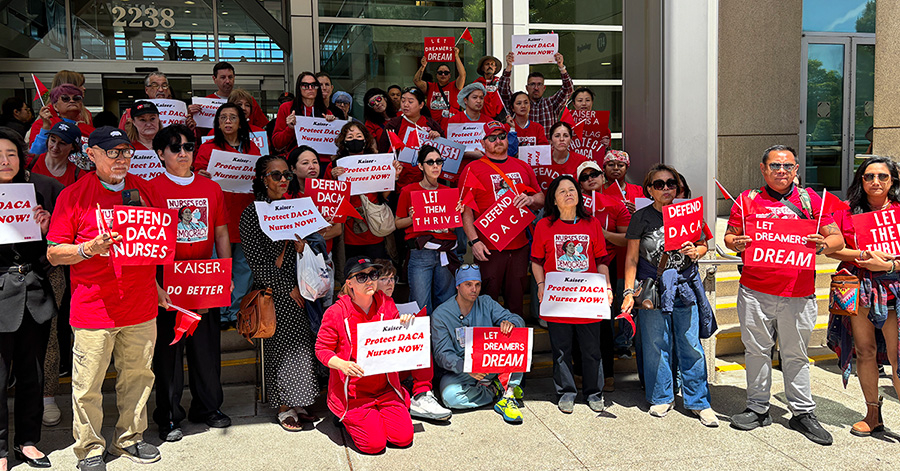
After learning her story, CNA nurse leaders and staff jumped into action. On May 11, they staged a packed rally of her coworkers, supporters, and local elected officials in front of her workplace, expressing their outrage that Kaiser would side with the Trump administration in vilifying immigrants and demanding that Kaiser retract its threat of termination. In addition to the visible protest, CNA nurse leaders lobbied elected officials and even the Kaiser CEO to intervene on her behalf. The local media covered her story widely.
All of it worked. Kaiser informed the nurse a couple of days later that it was extending her unpaid leave for an additional 30 days, and then soon after that, her DACA renewal was approved. She was able to return to work in mid June.
“I’m so thankful for the support of my union,” she said in an interview, with tears brimming in her eyes. “Many DACA recipients don’t have union support so it's huge to be backed up by the largest and strongest nurse union. It’s great to have this voice and be able to speak about this issue.”
Her case was not an isolated one. Over the past year, California Nurses Association/National Nurses Organizing Committee has learned of a handful of RN members who have DACA status and have run into major delays getting their status renewed. The United States Citizenship and Immigration Services (USCIS), the federal agency that processes these applications, has been inordinately slow with no clear explanations for why — though applicants can guess given the aggressively anti-immigrant stance of the Trump administration. As a result of processing delays, the lives of thousands of DACA recipients, or Dreamers as they are often called, have been thrown into fear and turmoil. Without active DACA status, they lose income, could lose health coverage, cannot have a valid driver’s license, and are in danger of being detained and deported. The nurses discussed in this article all came here as small children with their parents — with some arriving legally but then losing their status due to some change in their parents’ work situations.
CNA knew Kaiser’s threat of termination was unnecessary. Nurses whom CNA also represented in the University of California system had the foresight, during contract negotiations in 2025, to anticipate problems in renewing work authorization under the Trump administration and secured language that protected nurses’ positions by preserving their “recall” rights. UC nurses whose work authorization expired would not face immediate termination and would keep their seniority, schedule, and other aspects of their employment. A couple of UC DACA nurses had similarly suffered delayed renewals, but because they were clearly protected by contract language, they did not face the same panic as the Kaiser nurse.
But just like how union nurses can set and raise the bar for all nurses, Kaiser Nurse One’s case changed protections for other DACA nurses working within the Kaiser system. As a result of this fight, Kaiser signed on May 26, 2026 a letter of agreement that proffers reinstatement rights for seniority, sick leave, and education leave for up to a year in case a nurse is terminated due to a delay in work authorization processing. More than 25,000 Kaiser nurses are also currently bargaining for a new master contract this year, and they will be negotiating for additional language and protections for nurse members subject to work permit renewals.
Besides the letter of agreement, Kaiser Nurse One’s case did have an immediate impact on other DACA nurses in the Kaiser system. A different nurse, we’ll call her Kaiser Nurse Two, who worked at a facility across the bay was having the same exact problem: her DACA renewal was delayed. Because the first nurse ultimately received a total of 60 days of unpaid leave, the second nurse automatically also received 60 days. It would be barely enough.
Kaiser Nurse Two is originally from South America and has built a fulfilling career and life for herself here in the United States. A nurse for 10 years, she ended up marrying a U.S. citizen, bought a house with her spouse, and is also expecting their first child after some struggles to get pregnant. But what should have been a purely joyful time for her was marred by extreme stress after her DACA renewal was significantly delayed. Her situation was also complicated because she was unclear if her health care benefits — which were absolutely critical for her prenatal care — would be interrupted during her time on unpaid leave, and the months that she was not working meant she might not be able to accrue the needed hours to qualify for parental leave and pay. Her managers were indifferent and of no help to her in figuring out answers to her questions, much less advocating for her and thinking of alternative ways she could avoid termination.
Finally, her physical DACA renewal card came with only a couple of days to spare before the end of her 60 days. She was able to return to work in early July.
“It’s been a nightmare,” she said. “As an immigrant, it’s frustrating. This is impacting a lot of people and we are truly suffering. We need to open up pathways for us to get citizenship.”

Saving one of our own
How Maine nurses overcame the odds and successfully won release of a coworker kidnapped by ICE
The shocking news hit everyone’s phones Monday night, Aug. 3, 2026 via Maine Medical Center union nurses’ group WhatsApp chat: One of their fellow nurses, a medical-surgical nephrology unit RN named Debora Kapisha, had been kidnapped by Immigration and Customs Enforcement while traveling through Portland International Jetport the previous week. Kapisha, 28, was legally in the country and had authorization to live and work here in the United States until 2030 while she was waiting for her asylum case from Zambia to process.
But Trump’s deportation machine didn’t care. Kapisha was being held in Massachusetts and, according to her family and attorneys, was about to be shipped off to a detention center in Louisiana where she would be far from her family, friends, and legal counsel.
Maine Medical Center (MMC) nurses basically called a code and immediately launched into action. It was all hands on deck: nurses, union staff, union legal counsel. Nurses agreed they would do anything and everything to prevent her transfer and get her released. MMC nurses, who unionized in 2021, reactivated their extensive phone trees to inform colleagues about Kapisha and ask them to write letters of support to the court. Within hours, Kapisha’s coworkers had written more than a hundred letters attesting to what an exemplary nurse and person she is. “She’s a valued member of our community, of our hospital,” said Meg Sinclair, an MMC RN leader. “Her patients love her. Her coworkers love her. She’s just a very kind and loving person. She’s been in this country saving American lives.”
MMC nurses also decided to hold a protest near the hospital on Wednesday morning, Aug. 5, to demand her release. Nurses not only used their own phone trees to publicize the protest, but tapped into their extensive community and political social networks to invite neighbors, allies in the immigration rights and civil rights communities, local, state, and federal elected officials and candidates, including Troy Jackson and Hannah Pingree, and all concerned citizens. Within 18 hours, MMC nurses convened more than 200 people on the Western Promenade and all the local news media outlets.
“The unit Debora works on historically hasn’t had a ton of union activity,” said Sinclair. “But the second that they heard about [the protest], these nurses reached out and were willing to stand here in front of dozens and dozens of cameras — something they've never done before and is a really scary thing to do — and speak up on her behalf. They felt emboldened to do so because of the strength that was behind them and because of how much they love their coworker.”
Right before the protest began, MMC nurses received some good news: Kapisha would not be transferred to Louisiana. In the nurses’ eyes, their advocacy and organizing was already working. This was in stark contrast to the inaction of their employer, Maine Medical Center, who had not only delayed telling her union about her arrest after learning from her family the previous Friday, but also refused to “get involved.” Even worse, nurses know MaineHealth, which owns MMC, had contracted with the A.I. tech company Palantir in some capacity, and the U.S. Department of Homeland Security was spending billions on Palantir contracts, including applications to surveil and target immigrants for detainment and deportation. Nurses have been calling on MaineHealth to terminate the contract.
Kapisha’s story exploded and was covered extensively in local, regional, and even national media. The absurdity of imprisoning a working registered nurse who saves lives every day exposed the ugly truth of Trump’s cruel and inhumane deportation machine: The deportation program, anti-immigrant rhetoric, and billions spent were never about protecting people in the United States — whether from “criminals” or immigrants taking American jobs. The administration simply wanted to promote white supremacy by expelling Black and brown people from the United States while helping their corporate prison industry friends make billions doing it.
Maine nurses were already no strangers to ICE terror. Besides the reverberations felt locally and nationwide by the killings of Veterans Affairs RN Alex Pretti and activist Renee Good, 26-year-old Johan Sebastián Durán Guerrero had been shot and killed just weeks before in Biddeford, Maine. ICE had begun operations in the state in January, launching its perversely named initiative “Catch of the Day.” MMC nurses, patients, and the wider Portland community had already endured an extremely frightening period of ICE patrols and kidnappings: an environmental services workers had been taken, relatives of patients had been snatched, and a large percentage of the environmental services staff just stopped showing up to work because the risk of leaving their houses was too great. MMC nurses were personally driving vulnerable coworkers to and from work. “That was just really horrific,” said Kelli Brennan, an MMC nurse leader who had her own upsetting run-in with ICE while giving a coworker a ride. “A lot of our coworkers, not even just nurses, but nursing assistants, housekeeping, the folks that work in the kitchen were very scared and not sure what the future was going to be.”
But now ICE had taken a fellow registered nurse. “Having one of our own nurses abducted was just so deeply unsettling,” said Sarah English, an MMC nurse. “I think when something like this happens, it really hits home for people and they can see that it’s not just something that happens on the news to ‘the worst of the worst.’ It’s actually something that is affecting us. And if it happens to someone like this particular nurse, any one of us could be next.”
After the hugely successful protest, nurses were already strategizing about how to mobilize and transport coworkers to a Massachusetts courthouse the next week where Kapisha was scheduled for a hearing. They were in the thick of organizing when they got some stunning but joyous news Thursday: Kapisha was released from custody! “It was unbelievable. I couldn’t believe it,” said Brennan. “And I just started crying. It was just such a relief because we know that once they get to those detention facilities that it is not easy to get them back.”
MMC nurses held a victory rally the next morning on Friday, Aug. 7. Nurses credit their success in getting Kapisha released to being organized, union RNs who have had much practice working collectively. “Having a union absolutely made a huge difference,” said Janel Crowley, an MMC RN. “Without the union, we wouldn’t have felt safe to come out here and have our protest, have our press conference, and demand that ICE release her. We just would have been afraid.”
Kapisha, who is still recovering from her traumatic experience, did not wish to be interviewed for this article, but said in a statement read by a coworker at the Friday press conference, “Thank you all for your love and support. I am so thankful to be home and can’t wait to return to my coworkers and patients.”
She is now back at work but the fight is not over. She has more upcoming court dates, but now knows her union is fully backing her with support and resources. Kapisha’s story is a perfect example of how fighting together gets results despite the most challenging circumstances.
“To someone who’s feeling just despair and hopelessness, you can stay where you are and sit without, or you can get up and do something, and it doesn’t take the entire population to get up and do something,” said Sinclair. “Just a small amount of us can come together and make huge change.”
My life is here
Trump’s ending of temporary protected status for hundreds of thousands of Haitians forces one nurse into the shadows
Amanda feels like she is living on borrowed time. An intensive care unit registered nurse from Haiti with temporary protected status (TPS) living and working in California, she is technically deportable after the U.S. Supreme Court decided in June to allow the Department of Homeland Security to strip approximately 350,000 Haitians of TPS protections. Because she is in such imminent danger, we are calling her Amanda instead of her real name.
The United States under the Obama administration established TPS for Haitians after the island’s devastating 2010 earthquake. TPS is meant as a humanitarian program for people fleeing unsafe conditions in their home countries to temporarily be able to live and work in the United States. Conditions in Haiti have not improved, however, and continue to be extremely dangerous, with rampant gang violence and political instability verging on civil war. As a result, the TPS program has been repeatedly extended for Haitians, with recipients required to renew every 18 months. There are an estimated 103,000 Haitians working in health care, with about 50,000 on TPS.
New York State Nurses Association (NYSNA) RN members, especially those in New York City where the largest Haitian community outside of Haiti lives, have been outspoken in advocating for people with TPS. Led by NYSNA and NNU President Nancy Hagans, who is also a Haitian immigrant, they have held a number of rallies, press conferences, and candlelight vigils to protest the ending of TPS.
Trump during his first term tried to end TPS in 2017 for Haitians, but legal challenges ultimately blocked the effort and Amanda suspects he dropped his push due to needing Haitian health care workers during the Covid pandemic. He renewed his efforts once he took office in 2025, and again was met with multiple court challenges and stays. Under an extremely conservative Supreme Court, however, he has managed to end the program.
Over this past year, Amanda has been so stressed out following this TPS rollercoaster that she lost 20 pounds. She now pays rent month to month because she doesn’t want to sign a long-term lease. She sold all the furniture in her apartment except for her bed and two kitchen chairs. She never goes outside and only leaves her apartment to work occasional per diem weekend shifts. Her income has been cut in half. She returned her leased car because she could no longer afford payments and now rides the bus. She checks her email every two hours to see if her employer has terminated her. Her work’s HR department has tried to terminate her twice — before stays against ending TPS were issued. She is very afraid of being arrested and imprisoned in a remote detention center. She has a suitcase packed by the door. If she receives word that she’s fired, she will immediately figure out a way to drive by car to her sister’s house on the East Coast. Her plan? Hide in her sister’s basement.
“They’ll have to fight me to deport me,” said Amanda, who said that she has no home in Haiti and knows nobody there. She left Haiti 26 years ago when she was 18 years old at her mother’s insistence, because the violence was too intense. While she was in nursing school in Florida, gangs murdered her father, stabbing him to death and chopping up his body. “The only thing that keeps me going is knowing I’m not the only one. We have to stand together. This is a direct attack on humanity. It was never about criminals. It’s a direct insult to a specific nation, and it’s Black and brown. It’s an insult to democracy.”
From a young age, Amanda knew she wanted to be a nurse. Her grandmother suffered a massive stroke when she was a child and the entire family took turns caring for her at home. She never remembered the carework as a burden, but said that all the partying, studying, cooking, and sleeping happened wherever her grandmother was.
It took Amanda 10 years to get through nursing school, because she had to entirely pay her own way — not even qualifying for grants and financial aid due to her TPS. She took odd jobs in nursing homes and meat packing to make money. She went to school when she had money; she had to withdraw when she had no money. During nursing school, she did not even know if she would be able to secure work authorization to get hired as a registered nurse. Thankfully, the TPS program started around the time she graduated and she was able to successfully get approved. She worked in Florida before moving out to California after the pandemic.
She was living a full and happy life before Trump began attacking people with TPS; she loved her profession and caring for critically ill patients, she often went out on the town with friends and coworkers, she enjoyed the diversity of her city’s neighborhoods and cultures. Now she is always looking over her shoulder.
“They’re taking me from a working person to a homeless person,” said Amanda indignantly. “I have a purpose and my purpose was to become a nurse. And I have achieved it.”
Hagans was heartbroken by Amanda’s story and is simply outraged by Trump’s treatment and scapegoating of Haitians. “At a time when our hospitals and care facilities are already stretched thin, it is dangerous and unacceptable to take experienced, trusted workers out of the workforce and force them underground,” said Hagans during a special TPS virtual town hall hosted by NNU on Sept. 1. “We need Haitian people here, we want Haitian people here, and National Nurses United will fight like hell to ensure every single Haitian immigrant can lead a dignified life here in the United States.”
Hagans, who is herself a Haitian immigrant but has U.S. citizenship, is constantly fielding urgent phone calls from desperate members of her community and trying to connect people to resources. She said that others often ask her, “Nancy, why are you so passionate about TPS? You are not here on TPS.” Because, she answers, “I could have been her.”
NNU is trying to help Amanda sort out her legal routes for staying in the United States, but the options are very limited. Hagans said the government needs to immediately reinstate TPS for Haiti and other affected countries.
Despite what Trump’s cruel policies have stolen from Amanda, they cannot take her identity as a registered nurse. “I will never stop being a nurse, and a damn good one,” she said. “I will always stand for what’s right. I will stand and I will break the door to get what my patient needs.”