


We Keep Us Safe
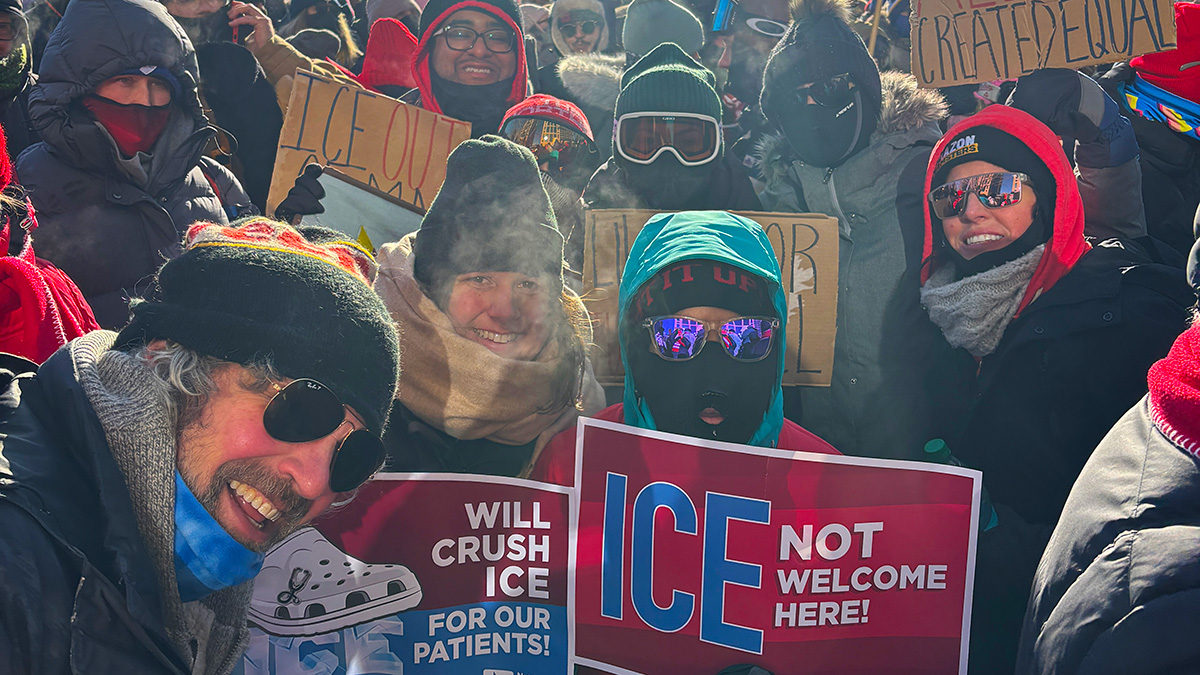
Nurses mobilize to protect patients, coworkers, and our communities against ICE, with a special look at the work of Minnesota nurses
By Lucia Hwang
National Nurse magazine - Jan | Feb | March 2026 Issue
Like all registered nurses, Chris Rubesch knows that nothing good ever comes from being scared and unprepared. “You don’t want to be going into an unknown situation when you’re afraid,” said Rubesch, a telemetry nurse in Duluth, Minn. who is president of the Minnesota Nurses Association (MNA) and a vice president of National Nurses United (NNU). “Bad things happen. As nurses, we prepare for all of that.”
So when Donald Trump took office in January 2025, immediately designating spaces like health care settings, schools, and places of worship as fair game for immigration enforcement and ramping up the anti-immigrant rhetoric, Minnesota nurses got busy. Concerned nurses approached the MNA board of directors about mobilizing to respond to potential attacks on Minnesota’s immigrant patients and communities, especially the large Somali and Hmong populations, and the union’s Immigration Task Force was born.
Nobody could have quite anticipated the scale of Operation Metro Surge, federal immigration agencies’ war on Minneapolis residents and the rest of the state, but at least MNA members were as ready as they could be.
“We see our communities at risk, and we identified this as a crisis,” said Rubesch. “We see what is happening and we protect us.”
From California, to Illinois, to Minnesota, to Maine, NNU registered nurses have been furiously organizing to protest Immigration and Customs Enforcement (ICE) activities and to demand that their employers adopt and enforce policies to side with nurses on keeping hospitals and clinics safe sanctuaries of healing and off limits for immigration enforcement. One of the benefits of solidarity as a national RN union is the opportunity to learn from and model one another, to share knowledge about tactics and strategies that work and do not work. We have previously reported on some wins by our affiliates, such as passage in California of S.B. 81, a law sponsored by California Nurses Association, that strengthens privacy provisions for immigrants in health care settings and more clearly restricts access to federal enforcement agents.
The greater Los Angeles metropolitan area has been dealing with daily but dispersed ICE kidnappings since last summer, but the “enhanced operations” that cities like Minneapolis, Chicago, and Portland, Maine, experienced are a whole other beast. In these “surges,” thousands of agents invade the city, violently rounding up nonwhite citizens and noncitizens alike in an indiscriminate dragnet. Minneapolis bore the brunt of this approach, Portland suffered for more than a week, and, as of this writing, ICE is expected to surge operations across California with news reports that it is aggressively leasing and opening physical offices in cities like Sacramento, Irvine, Santa Ana, and San Diego.
NNU has consistently stated that ICE actions pose a major public health threat on multiple levels to our patients, our communities, and our democracy. That danger was never more apparent than after border patrol agents on Jan. 24 gunned down Alex Pretti, an intensive care unit RN who worked at the Minneapolis VA, for simply observing and filming them. Pretti’s murder, on top of Renee Good’s killing earlier that month, galvanized nurses across the country to hold an entire week of vigils to demand justice for him and all killed by ICE.
Pretti’s killing further crystallized ICE’s motives for the U.S. public: People could see that the agency’s purpose is not immigration enforcement, but rather to serve as President Trump’s paramilitary police — accountable only to him — to quash popular opposition to his fascist, white supremacist takeover of our democracy. Nurses have assessed that ICE is beyond reform, and the agency — which was only created after the 9/11 terrorist attacks — needs to be abolished. NNU’s position has been that it is wrong to steal nearly $1 trillion from Medicaid and Medicare through last year’s budget bill H.R. 1, just to give billionaires tax cuts and $75 billion to ICE. Taxpayer dollars should go to provide health care to the U.S. people, not attack them. On Feb. 19, thousands of NNU nurses at more than 55 facilities around the country held a national day of action to demand that Congress stop funding ICE and dismantle the agency.
“They picked on the wrong profession,” said Mary Turner, an ICU RN in the Twin Cities and also an NNU president. “When we saw people murdered like that, that was a wake-up call. The reality is: No one is safe. No one can say, ‘This can’t happen to me.’ It’s official now.”

By the time federal agents descended in full force on the Twin Cities in late December in what the government called “Operation Metro Surge,” Minnesota Nurses Association had already been educating and organizing nurse members for almost a year on what to do when encountering federal immigration agents, what patients’ rights are, and what health care workers’ rights and responsibilities are. MNA partnered with all facets of the community, meeting with immigrant rights groups like Unidos MN, faith organizations, other labor unions — especially those that represent a large number of immigrant workers in the service and hospitality sectors, and legal aid groups. MNA created badge buddies printed with instructions for nurses about how to protect patients’ rights, a sentence to say out loud to agents, and a QR code for more resources.
MNA members quickly plugged into both workplace-based and community-based networks to provide mutual aid and support, including using existing contract negotiation and bargaining unit networks to establish safe ride carpools, parking lot escorts, grocery delivery, and in-case-of-emergency plans for coworkers to deploy so that households could be notified, family lawyers called, and children picked up from schools and day cares in case anyone went missing. The needs were extensive because almost all at-risk Minnesotans had stopped making unnecessary trips and were staying at home.
“It almost brings me to tears to think about the horrors of the reality we are dealing with, but also feeling heartened and hopeful seeing the solidarity, the compassion, the care that members were showing for each other,” said Rubesch of all the creative and ongoing mutual aid everybody was providing. “Just the power in seeing people stepping up and coming together.”
NNU members in Maine, which was also targeted for all-out assault by ICE starting Jan. 21 in operation “Catch of the Day,” watched and learned from their colleagues in Minnesota. Maine Medical Center RN Kelli Brennan in Portland said it felt like their city had been attacked overnight. In one day, everyone started seeing news reports and social media videos of immigrants and Black and brown Mainers getting pulled over, arrested, cars left running with doors open in the middle of the street, ICE agents showing up in grocery store parking lots. When ICE almost immediately detained a member of the housekeeping staff at Maine Med, that news reverberated throughout the hospital like a shockwave. Scared to death of being nabbed while going to and from work, environmental services staff began calling out en masse, with about 30 percent ultimately not feeling safe to go to work. Soon after, nurses learned that a new father who had made a trip home to get his wife’s personal items after an emergency C-section had been nabbed.
The nurses got to work, not only lobbying the hospital to set policy and use its resources to protect employees, but also establishing those mutual aid networks that prove so invaluable in helping families meet their everyday needs. The nurses successfully convinced the hospital to make changes, such as moving the weekly food bank to an indoor, non-public location, and diverting some of its employee parking lot shuttles to pick up and drop off staff at their front doors. Brennan herself immediately began giving coworkers rides to work.
The day after the surge started, Brennan was driving a unit secretary coworker to the hospital around 6:15 in the morning when she noticed men standing around in a driveway with cars. Brennan was already a member of the networks of neighborhood patrols reporting ICE sightings, cars, and license plates to rapid response groups, so she pulled into a parking lot across the street and began filming the men. She never spoke to them, honked, or made any noise — just watched and documented.
The group soon made her aware that they knew she was filming by flashing lights at her. A little spooked, she decided to leave and concentrate on just safely delivering her coworker to work. But some of the people got into a car and followed her. “Stay calm, it’s probably local police and not even ICE,” she thought to herself. At the next stoplight, they pulled up next to her, rolled down their window, and stared her down. She rolled her own window down, and that’s when the ICE agent called her a “Karen” and tried to peer inside her car. When Brennan used colorful language to tell them to leave her city, she said the agent sneered that he would “arrest three more families today, just for [her]” and sped off. Brennan and her coworker were stunned by the cruel attitude of the agent, and sat in silent shock for a while, crying. “ICE is just feeding this racist appetite,” said Brennan. “I felt awful that my coworker was exposed to that. We were disgusted.” ICE presence has slowed in Portland and instead crept into other agricultural areas of Maine, but Brennan still drives around on her days off, reporting suspicious vehicles and staying vigilant. And she is glad to report that both the housekeeper and new father who were kidnapped have been released for the moment on bond.
“They try to intimidate us,” said Brennan. “But we won’t be intimidated.”
Rubesch and Turner both expressed the same sentiment: Determination while facing our fears.
Turner said that these days, she is wary of driving on the freeway and she’s constantly scanning the cars around her for SUVs with tinted windows. “But then I continue to show up because I remember, ‘This is what these assholes want,’” said Turner. “This is not America. This is not how it should be. It takes more courage to keep going when you are afraid.”
Rubesch said the first reaction among nurses when they see or hear of terrible violence by ICE against Minnesotans is often fear. “But the second emotion is resolve,” he added. The hopeful outcome of the crimes his state has suffered at the hands of federal agents is that “everything that’s happened has changed their frame and gotten them to engage.”
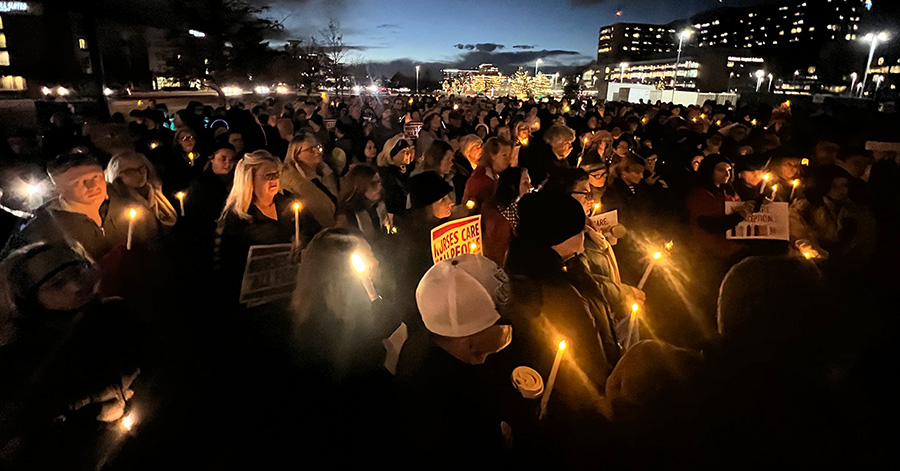
While ICE and Customs and Border Patrol (CPB) activities have slowed down in Minnesota and Maine, they have not stopped, and Rubesch said mutual aid and nurse organizing will continue for as long as it is needed. Minnesota nurses are now moving beyond responding to the immediate safety crisis and working with coalition organizations to make comprehensive lists of demands from both hospitals and elected officials. The need for creative policies and protections for patients, workers, families, and communities really hit home for Rubesch when he considered how instrumental an expansive state sick time law passed about two years ago was to Minnesotans’ resistance to ICE.
Called the Earned Sick and Safe Time law, it requires employers to provide a certain number of hours of sick leave to all employees working more than 80 hours per year. But perhaps equally transformational are the expansive rules about what that leave can be used for: not only to care for and attend medical appointments for yourself or family members, but to include friends, neighbors, or anyone who relies upon you as your chosen family. The leave can also be used when an employee does not feel safe to go to work.
“It was so fortuitous that this passed when it did,” said Rubesch. “Because of this law, our nurses were able to use it to defend their communities, to say, ‘I need to be in my community today because there is an ICE patrol running and I can’t leave my neighborhood.’”
Minnesota Nurses Association also worked with its partners to create a model policy for hospitals that would be most protective of patients and workers, which included provisions such as not allowing ICE into care units, ensuring agents carry no firearms into the building, banning agents from being in the room when patients are receiving care, and ensuring that patients have access to certified interpreters, social workers, and legal resources. MNA decided to first approach Hennepin County Medical Center to adopt the model policy, not only because it represents the RNs there, but because it is the largest trauma facility in Minneapolis, a publicly owned hospital, and ICE regularly took detainees there for medical treatment. Due to some other organizing that MNA was leading, last year the county commissioners assumed direct control of the hospital and it was no longer governed by an intermediary board. MNA and labor allies were able to apply pressure to commissioners, who in mid January adopted an ICE policy for the hospital that was largely what the unions had advocated. Now that MNA has won a foothold, it is working on convincing every hospital in the Metro area to adopt the policy. It is also requesting a meeting with the Minnesota Hospital Association to demand that its hospital members adopt the policy.
Rubesch said that union nurses will not stop advocating for patients on every possible level. “We continue to be present and add our voices and our names to a whole host of public demands of elected officials, standing in solidarity with community demands and any other creative approaches to push back,” he said, giving examples of a proposed statewide eviction moratorium to protect workers who have been afraid to work and cannot pay rent, and another proposal to review liquor licenses of restaurants that are serving alcohol to federal agents carrying firearms.
“We nurses are leading the care team not only at the bedside, but also the community,” said Rubesch. “We are everywhere, at our church organizations, at our kids’ soccer teams. We made us ready, and everything we’ve done makes me really proud of our membership.”
Lucia Hwang is editor of National Nurse magazine.