


The Power of the ADO
Documenting unsafe conditions protects your license and your patients
By Chuleenan Svetvilas
National Nurse magazine - Jan | Feb | March 2026 Issue
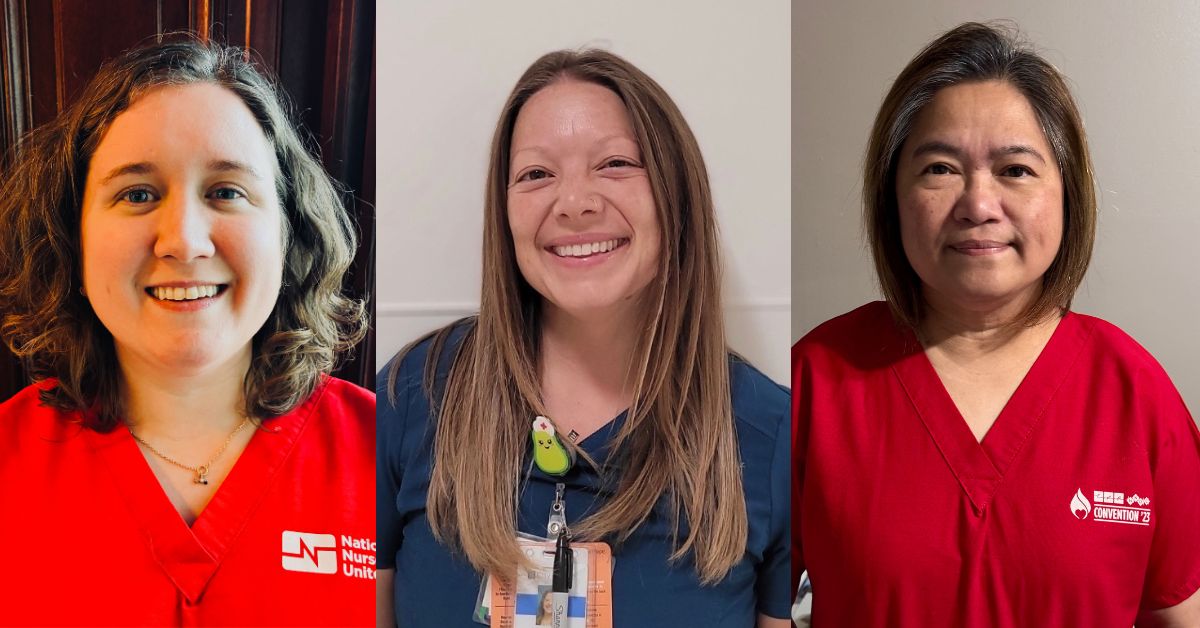
“You have to fill out the ADO, otherwise patient care is compromised,” says Michelle Kubota, an RN for 25 years at Seton Medical Center in Daly City, Calif. “The ADO is very important to protect your license. Management or the supervisor will know that you are protesting that the assignment isn’t safe for your patient or your license.”
Anna Lendabarker, RN at UChicago Medicine wholeheartedly agrees. “ADOs are a great resource to document any staffing or safety issues that come up,” says Lendabarker, who has worked at UChicago since 2013. “In Illinois, we don’t have a ratios law, but the ADOs protect the staff and are a real-time documentation of issues that are going on with the hospital.”
The Assignment Despite Objection (ADO) is an independent documentation system that the Professional Practice Committee (PPC) uses to track and document unsafe conditions — everything from short staffing and missed breaks to unsafe floating and more. The PPC, an elected committee of staff registered nurses representing every major nursing unit, has the power to document unsafe practices and make changes. When nurses fill out the ADO — a four-part carbonless form — the top copy goes to the supervisor, the second copy to the PPC, the third to the labor representative, and the bottom one is retained by the nurse or group of nurses who fill it out.
“We have a pretty robust culture at UChicago to utilize ADOs,” notes Lendabarker, who is the ADO chair of the PPC at UChicago Medicine in Chicago, where National Nurses Organizing Committee represents about 3,000 nurses. “We routinely get 100 to 200 ADOs a month. I encourage everyone to submit ADOs as a group because typically if one person’s assignment is inappropriate, that’s also the case for others.”
When one nurse in a unit can’t take a break, that usually affects the entire unit, says Tinny Abogado, RN in the step-down unit and chief nurse representative at Kaiser Permanente Los Angeles Medical Center (LAMC), where California Nurses Association (CNA) represents nearly 1,300 RNs. “We fill out the ADO as a group so there is less fear of retaliation,” says Abogado, who has worked at Kaiser LAMC for 24 years. “Each nurse prints their name and adds their signature.”
“If you complete the ADO and the supervisor doesn’t resolve the issue, it’s documented,” notes Kubota, PPC chair at Seton, where CNA represents nearly 300 nurses. “The details on why you think it’s an unsafe assignment and how patient care is affected is in the ADO.”
If a nurse is accused of missing something or making a mistake, they can pull out the ADO for that date and show concrete documentation that reports what was happening that day, such as short staffing, and how that affected patient care. According to Reanna Felix, an RN in the emergency department at Seton, people on her unit who made a med error have been saved by the ADO. Felix says they didn’t get in trouble because the ADO showed the shift was understaffed and they were busy with other patients. Romina Legaspi, a critical care RN and PPC chair at Kaiser LAMC has a similar example of a nurse who was facing corrective action, but because he filled out an ADO, he was able to show that it was short staffing, not negligence, that created the issue with the patient. “With the ADO, you have a good rebuttal,” says Legaspi. “The ADO made a big difference for the nurse.”
“The ADO is a document that can stand up in court. It can literally protect you if you are taken to court,” says Fran Alexanderson, an RN in the hematology/stem cell transplant unit and co-chair of the PPC at City of Hope in Duarte, Calif., where CNA represents 1,700 nurses.
“I started filling out ADOs from Day 1,” says Felix, who began working in March 2025 when the ED was chronically understaffed. “My parents have been nurses for 25 years. My mother told me about the importance of filling out ADOs.”
When Felix first began working at Seton, ED nurses had not been filling out ADOs due to the manager’s lack of response, but Felix reminded them, “You don’t want to lose your license. You never know when you’ll need the ADO.” Her example and encouragement worked and now ED nurses regularly fill out ADOs as needed. They fill them out as a group. Felix also staples the ED staffing sheet to the ADO, which shows just how short staffed that shift was. As a result of ADOs and a petition of no confidence in the ED manager, staffing has improved.
The ADO is how nurses hold management accountable. If management does not resolve the problems during the shift and if it is an ongoing or egregious issue, the PPC can directly address it with management at a PPC meeting. Some issues can be resolved more quickly than others. To be sure, some nurses may wonder why they should continue filling out ADOs when management is slow to respond, but ADOs are very helpful for identifying trends, providing extremely useful data in contract negotiations. This is why it is crucial to continue filling out the ADOs: The data will show management that the issues are ongoing and need to be addressed or patient safety remains at risk. Without documentation, the conditions will not change.
ADO data was critical during City of Hope contract negotiations in 2024. The nurses brought a giant stack of ADOs and gave a presentation about why they needed resource nurses to provide break relief. They were able to show that in 2023, RNs filed 846 ADOs, documenting their concerns with unsafe staffing and missed meal and rest breaks, reporting that 92 percent of the ADOs cited inadequate staffing as the reason for filling out the form. The result? The RNs won resource nurses for all inpatient units in the four-year contract they ratified in June 2024.
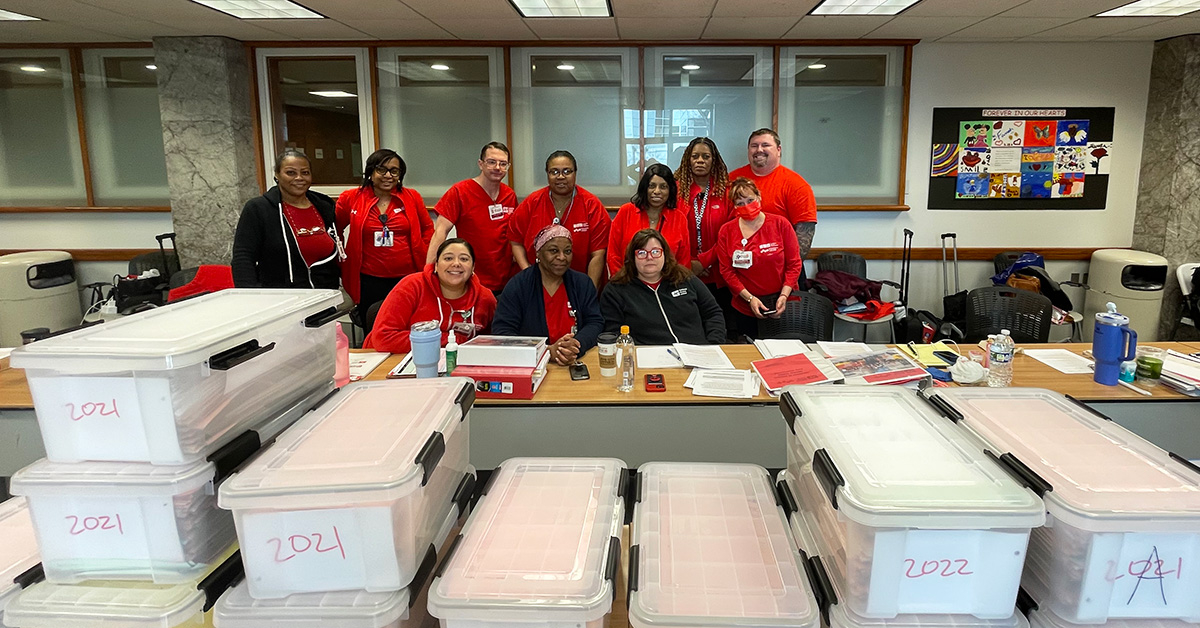
UChicago nurses also find ADOs very effective during contract negotiations. The nurses come to the table with what Lendabarker refers to as their ADO “mountain,” stacks of huge file boxes stuffed with ADOs. The ADOs were key to the nurses’ last contract negotiations. They won a dedicated meal- and break-relief nurse in the adult emergency department and a commitment that charge nurses will not be assigned a patient load in nearly a dozen new units.
Missed meal and rest breaks were also a big issue for Kaiser nurses at their last contract negotiations in 2022. “Nurses were so pissed off about management just denying lunch breaks and not even attempting to rectify that,” recalls Monte Wright, RN and PPC member at Kaiser San Jose in San Jose, Calif. “They said, ‘We’ll just pay the penalty.’”
Management was not listening to the nurses so they wanted to show them what was going on. The Kaiser San Jose nurses met in the cafeteria to tape together about 600 ADOs into one very, very lengthy piece of paper to protest short staffing. “We were holding this long document that snaked through the hallways, past administration offices, and out to the front door of the hospital,” says Wright, who has worked at Kaiser San Jose for 17 years in the perioperative unit. “It was unforgettable and so powerful. We were able to get language in our contract surrounding meal-and-break relief.
The hundreds of ADOs got their attention. “ADOs act as leverage to get your point across,” says Wright. “Sometimes we will just walk about with the form and management will run to fix the problem.”
Chuleenan Svetvilas is a communications specialist with National Nurses United.