


No Surrender
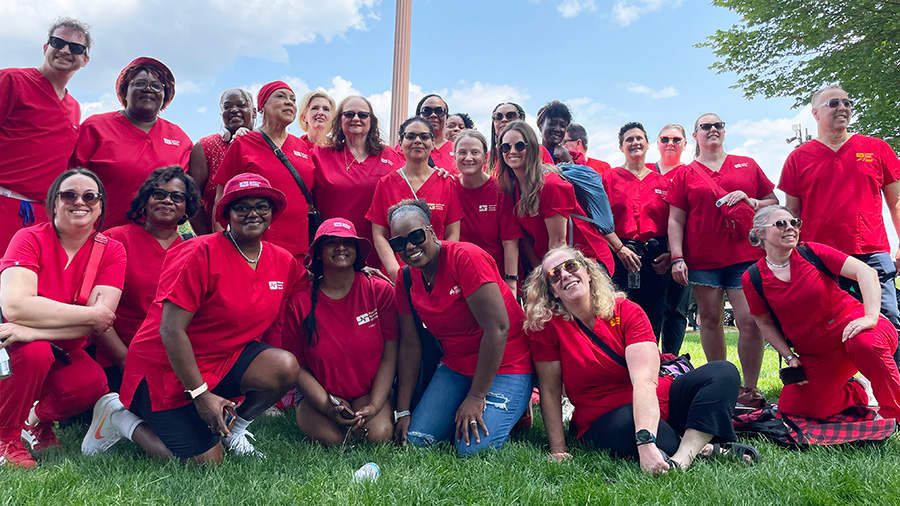
Despite hard conditions, Veterans Affairs nurses never stop fighting for their rights and their patients
By Lucia Hwang
National Nurse magazine - April | May | June 2026 Issue
We’ve all faced union-busting employers before. But what if your boss is the federal government and the head union buster is the president of the United States?
That’s the situation that National Nurses Organizing Committee/National Nurses United’s (NNOC/NNU) Veterans Health Administration (VA) nurses are battling now. Since President Donald Trump took office, VA leadership has attacked the VA workforce, dramatically cutting staff through the infamous “fork in the road” email and conducting massive layoffs, what the VA calls “reduction in force.” The VA secretary said the system aimed to cut 30,000 jobs by the end of fiscal year 2025.
Then in August 2025, the VA abruptly announced it was terminating its contract with VA nurses — supposedly to comply with a March 27, 2025 Trump executive order that forbade agencies doing “intelligence, counterintelligence, investigative, or national security work” from having collective bargaining agreements with employees. NNOC-NNU VA filed a lawsuit in April 2025 challenging this executive order, and is working to pass the Protect America’s Workforce Act, a federal bill that would restore their union protections and rights. But in the meantime, the VA nurses, who have had a union contract for more than two decades since 2004, were suddenly being told by management that they no longer had a union, no contract, no official time or office space to handle union business, and that they couldn’t conduct any union activities using work email addresses or on VA property. Soon, management eliminated automatic dues deduction from VA nurses’ paychecks. During Trump’s first term, VA management had also eliminated official time and space, and dragged its feet on signing its contract with nurses, but it did not deny the union’s existence. Now the VA nurses were in totally new territory in advocating for themselves and their patients.
The VA nurses we interviewed for this article, all of whom are speaking as union officers and not on behalf of the VA, did not want to sugarcoat the situation. Work has been very hard. Management has targeted leaders for discipline. Patient care has suffered due to the cuts. Morale is low. But they all also completely rejected any talk that their union no longer existed and remained strongly committed to fighting for and exercising their union rights on behalf of themselves, their coworkers, and their patients to maintain and improve the special care they provide to veterans.
“An office space is not a union,” said Irma Westmoreland, RN who is not only a longtime leader in the VA division, but also secretary- treasurer of NNU, the national organization with which NNOC is affiliated. “The union is actually the nurses. The nurses come together to work together and fight for their patients’ rights and their own rights, to better their working conditions, and to ensure safe care for patients. We can’t give up those rights just because President Trump writes an executive order.”
Her fellow VA nurse leaders agreed. “We don’t need anyone’s permission to act as a union,” said Cheryl Walden, a Clinical Call Center (CCC) RN who is vice president of the Dayton, Ohio CCC. Walden strongly believed that not continuing to organize and fight within the VA system, especially during these tough times, was shortsighted and would set the nurses behind when circumstances do change. “This administration will not be around forever. This is temporary.”
VA nurses are setting an inspiring example of how nurses can still fight and win even when the odds are stacked against them, and of the true meaning of what it means to be in a union.
Daphne Quinn, a telemetry RN and director of the Central Iowa VA in Des Moines, sums up the VA nurse leaders’ attitude: “We’re playing the long game.”
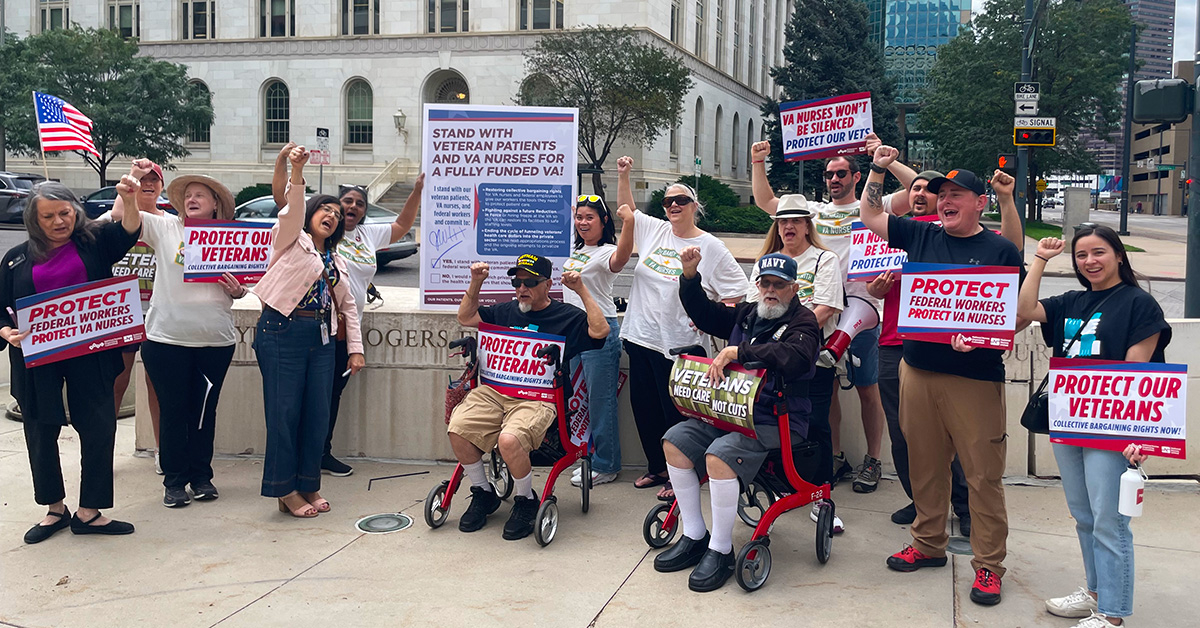
Nurses agree that it’s been challenging to do union work under the VA management’s new, hostile, and restrictive rules, but it can — and is — being done. And nurses are still getting results.
“Them not recognizing our contract, no longer having protected union time and offices was a loss, but our union is still very present, and we’re still very active,” said Heather Fallon, an RN who works in the emergency department at the James Lovell VA facility in Chicago, Ill. “We have to be more creative in how we operate, but it’s made us stronger. We have had to spend more time having face-to-face conversations with members and to build a broader base of support within our communities. We’re building relationships with nurses at other VAs, and we’re having conversations with our patients, with our veterans, with our communities with our point of view and moving forward in new ways.”
Among the first orders of business for VA nurse leaders has been establishing new communication channels with members, whether that’s through collecting personal email addresses or connecting members in group chats via WhatsApp or WeChat-type applications. Nurses have also had to get colleagues to rejoin as dues-paying members. They’ve moved meetings online, or to local cafes, restaurants, and hotel conference rooms during off-duty hours. “Even though they took away our email, so what? We still have our union. We still have clear access to them,” said Florence Uzuegbunam, a nurse practitioner who works at and is director of the Atlanta VA. “We use our WhatsApp group chat as a forum to make sure they know what’s going on. We still hold our meetings. If members have issues, we have a personal email group. We have a great labor rep, and he is always available to join by Zoom, to consult after hours.”
All of the nurses pointed out that almost all of the fights they waged under their contract are still possible now — it’s just that they are citing different reference documents or taking action under a different name. They still fill out assignment despite objection forms against unsafe staffing, they still file grievances, they still sit in on meetings where coworkers may face discipline, they still challenge managers’ bad behavior. Now they just cite the VA employee handbook when they file administrative grievances, and they represent coworkers as “peer witnesses” on their own time and don’t call the meetings “Weingarten” meetings. Their complaints against managers may have to be filed as equal employment and opportunity cases and they may now be speaking out to Congress, the VA committee, Occupational Safety and Health Administration (OSHA), the office of special counsel, or the inspector general’s office under whistle-blower protections instead of their union contract. They can report patient safety issues, anonymously or not, to the joint patient safety reporting system.
“If something happens, we have ways to help them address it,” said Walden, the CCC nurse. “The VA has handbooks that are pretty comprehensive.”
Westmoreland agreed. “We hold them accountable to the handbooks that they’ve got. And they’ve got a million of them! We show the nurses the options they have now and show they can use them.”
“I still tell the nurses, we still have our avenues — it’s just a different way to do it,” said Uzuegbunam. “Use the VA handbook. They are constantly violating their own handbook.” The nurses observed that managers often are not versed in the VA’s own policies and just blindly follow upper management’s orders to union bust.
In this manner, VA nurses have continued to stand up for their colleagues in all types of situations. Many have successfully gotten discipline reduced or dismissed for other nurses. Fallon and Westmoreland have pushed back against management’s attempts to prevent them from exercising their First Amendment rights to speak to the news media. The nurses still rally, protest, and organized well-attended vigils for VA RN Alex Pretti when he was killed by Customs and Border Patrol in January.
Walden said the CCC nurses, who do telephone triage when veterans call, have gotten management to back off from implementing ever-draconian limits on average call handling times by making and distributing flyers to members, veterans, and the community. Even though nurses can’t post the flyers or hand them out at work doesn’t mean they can’t send them electronically to everyone’s personal email addresses or make sure veterans groups get them so that they can barrage supervisors by phone and email with support for the nurses. “It works. People call,” said Walden. “It’s always a bonus when we get the veterans to call.”
When Uzuegbunam discovered during recent performance evaluations that managers were ordered to give nothing higher than a “satisfactory” rating, she appealed the designation and presented her case. “I’m not ‘satisfactory,’” said Uzuegbunam. “I am doing things above and beyond. I have a doctorate, I educate and teach and present continuing medical education courses outside the VA. They were pissed off at me for challenging it.” Though she believes she should have gotten her typical “outstanding” rating, they still had to rewrite her evaluation to reflect a “high satisfactory” ranking. So she won.
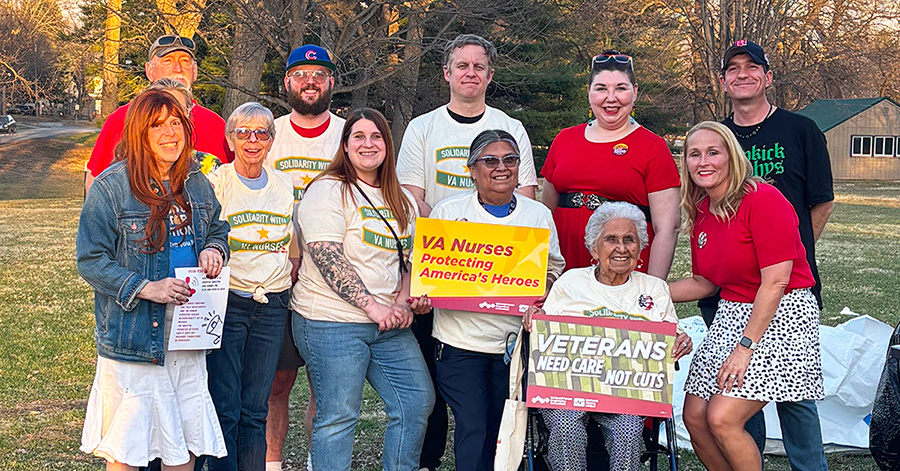
Why suffer within the VA system? All the VA nurses agreed that they choose to stay and fight because they care deeply about taking care of their veterans. “All of the nurses that I work with care a lot about the veterans,” said Quinn. “Honestly, it’s pretty nice to be part of a health care community where we’re all taking care of patients together. The cases I remember are the ones where I was able to get a really nice win for them, to connect them with services they need, or to catch a medication that is too high or too frequent, and to have it reverse their symptoms. To have an ‘Aha!’ moment with.”
Even though VA leadership has not targeted clinical staff for layoffs, the nurses report that the system has failed to replace RNs that they have lost through attrition, that the infamously slow hiring process has been made even slower because they have eliminated human resources positions, and that RN workloads and responsibilities have skyrocketed due to elimination of unit secretaries, housekeeping staff, transport staff, and all those support positions that keep VA facilities running so that nurses can provide clinical care. Understaffing is rampant.
“There are chunks of time where we don’t have ANY housekeeping staff, or people to do CT scans, to do transport, answer the phones, page doctors,” said Fallon. “Nurses are absorbing those tasks. That alone significantly impacts care. Clinical care is really being affected despite them saying that’s not the case.” Fallon was quoted in a March 2026 New York Times article saying that sometimes her hospital regularly does not have enough ultrasound technicians available and must send patients outside of the VA system to the private sector — what the VA calls “community care” — for services.
Quinn also reports that nurses are very worried VA facilities like hers are losing services as they lose staff. “We don’t have pulmonology anymore, which is important for the ICU,” said Quinn. “We lost dermatology. We lost half the podiatry staff. We lost at least half of our GI doctors, we don’t have enough radiologists either. We’re running clinics on bare bones. Not only are we trying to manage more patients with fewer staff members, but the patients have more complex conditions and needs as time goes on.” She cited VA health coverage of veterans exposed to burn pits as an example.
The nurses fear that conservative Republicans’ endgame of completely privatizing the Veterans Health Administration will be the result of losing so many staff and services. Ultimately, the VA will not be able to provide the care — not because they don’t know how or don’t excel at caring for veterans — but simply because there will be no one left to do it. To the VA nurses, sending their veteran patients to typical private-sector health care settings would be a travesty.
Walden, whose own brother is a veteran and on whose behalf she has had to fight to get a proper diagnosis and care, said that private-sector health care does not understand the culture of veterans. “They know their team, they trust in the VA and it’s almost like a social setting for them,” said Walden.
So for their veteran patients, the VA nurses continue to wage war against the union-busting Trump administration. It is difficult, but “nurses show up for patients. We do hard things all the time,” said Fallon. Surrender is not an option.
“Does the department attack us? Yes. Will they continue to attack us? Yes, they will,” said Westmoreland. “But we will always be a union.”
Lucia Hwang is editor of National Nurse magazine.