


New York City nurses win after largest nurse strike in city history
By Andrea Penman-Lomeli
National Nurse magazine - April | May | June 2026 Issue
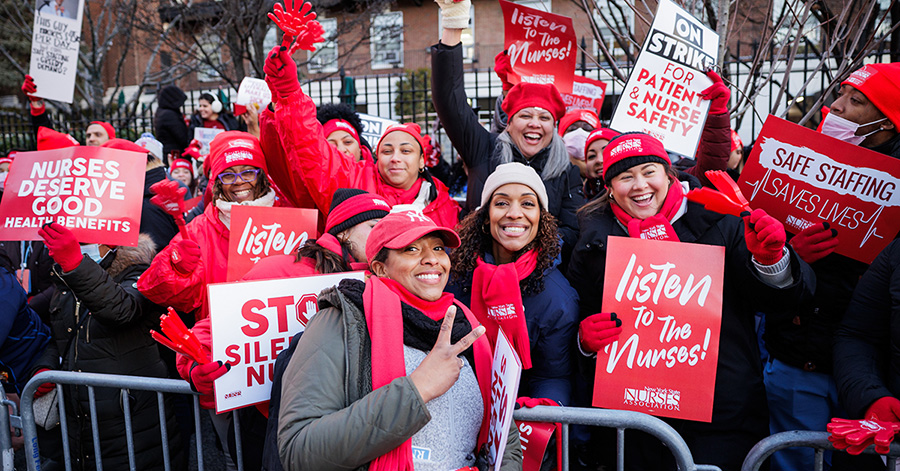
On Feb. 26, the last striking New York City nurses walked back into the hospital for the first time in 41 days. The largest and longest nurse strike in New York City history officially ended with hugs, tears, cheers, and reunions.
Anatomy of the Strike
The road to win fair contracts for all 20,000 New York City private- sector nurses, including all 15,000 striking nurses, was long. Three years ago, New York State Nurses Association (NYSNA) nurses at the same 12 hospitals came together for the first time to win groundbreaking contracts that set a new standard for enforceable safe staffing standards and wages in New York City and beyond. That contract campaign involved a three-day strike at Montefiore and Mount Sinai that delivered precedent-setting staffing enforcement language that has benefited NYSNA nurses around the state.
This time, 20,000 New York City NYSNA members began escalating their campaign to build public awareness in August. In early January, after months of bargaining, nurses at all 12 hospitals voted overwhelmingly — 97 percent — to authorize a strike, letting employers know they would strike starting Jan. 12 if hospitals failed to negotiate fair contracts.
Nurses at the eight safety-net hospitals made slow but steady progress at the table. Those hospital executives let members know they didn’t want a strike. However, the richest hospitals were ready for us. Before the strike even began, the president of the Greater New York Hospital Association told reporters that these hospitals already spent $100 million on expensive replacement nurses and were ready to spend more. They launched vicious public relations and union-busting campaigns and at the bargaining table, dragged their feet on nurses’ contract priorities, threatened to discontinue or drastically cut our health benefits, asked for givebacks on safe staffing, and refused to propose percentage-based wage increases.
Just days before the strike deadline, safety-net hospital nurses at BronxCare, Flushing Hospital Medical Center, Maimonides Medical Center, One Brooklyn Health Interfaith Medical Center, One Brooklyn Health Kingsbrook Jewish Medical Center, Richmond University Medical Center, The Brooklyn Hospital Center, and Wyckoff Heights Medical Center were able to win strong language to protect nurses from workplace violence, protect nursing practice from artificial intelligence (A.I.), and protect immigrant and trans patients and nurses. Those bosses agreed to maintain health coverage and to pay an average of whatever wage increase nurses at the wealthy academic hospitals won.
While nurses at safety-net hospitals all reached tentative agreements before the strike deadline, the richest hospitals continued to stall, holding health benefits hostage and still asking for givebacks — pushing 15,000 nurses out on strike.
Nurses on Strike
Before the sun had even risen on Jan. 12, nurses at Montefiore, Mount Sinai Hospital, Mount Sinai Morningside and West, and NewYork-Presbyterian streamed out of their hospitals, holding signs; packing the sidewalks in front and around the sides of their hospital buildings with chanting, music, and horns. For the next few weeks, nurses showed up and spoke out for patient and nurse safety and fair contracts.
Members received tremendous support daily from labor, community, and elected allies as well as patients, other union members, and everyday New Yorkers. During the coldest winter in a generation, NYSNA members at all of the hospitals spoke out at a dozen press conferences with powerful supporters, including Mayor Zohran Mamdani, Sen. Bernie Sanders, and New York State Attorney General Letitia James; dozens of Congressmembers, state legislators, and New York City Council members; and key labor and community allies. To keep the city’s attention and draw attention to patient safety concerns, nurses got creative with actions: They hosted a candlelight vigil with the parents of pediatric patients; held a family day of community service on Martin Luther King, Jr. Day; organized a fun run between picket lines; picketed in front of greedy hospital executives’ homes and businesses, and engaged in civil disobedience.
On Jan. 29, NNU and NYSNA President Nancy Hagans, RN spoke at a vigil to honor Minnesota nurse Alex Pretti, RN, whom U.S. Customs and Border Patrol agents killed. The action was co-coordinated with National Nurses United and labor allies at the VA New York Harbor Healthcare System. It drew more than 1,000 protesters, including dozens of striking NYSNA nurses, sending a strong message to keep Immigration and Customs Enforcement out of hospitals.
While nurses waged a campaign outside, we continued to fight for fair contracts at the bargaining table. Nurses at Montefiore, Mount Sinai, and Mount Sinai Morningside and West finally reached tentative agreements on Feb. 9 and returned to work on Valentine’s Day, Feb. 14. Nurses at NewYork-Presbyterian reached a tentative agreement on Feb. 20, returning to work on Feb. 25, ending the historic strike after 41 days.
Once again, NYSNA nurses worked in coordination to raise standards for everyone, winning contracts that achieve enforceable safe staffing standards with make-whole remedies in every hospital and increase the number of nurses to improve patient care at all hospitals; protect their health benefits, with no additional costs to nurses; protect nurses from workplace violence; protect immigrant and trans patients and nurses; safeguard against A.I. in all contracts for the first time; increase salaries by more than 12 percent over the life of the three-year contract to recruit and retain nurses for safe patient care; beat back aggressive takeaways on health care and safe staffing enforcement; and return all nurses to work after ratification.
More Challenges Ahead
Although nurses returned to work holding their heads high, nurses must also continue to fight to ensure that hospitals put patients over profits. This contract campaign and strike showed us that it’s possible. We showed the power of nurses.