Resistance and Resilience
An Art exhibit for National Nurses United’s 2025 Global Nurses Solidarity Assembly
This juried exhibition features the compelling work of 30 artists from across the country whose work embodies the themes of resistance and resilience. Their diverse work addresses a range of issues: labor rights, environmental health, human rights, mental health, civil rights for disabled people, and more.
“Everything is at stake for our patients, our families, our communities, and our planet. But we can take solace in the fact that union nurses can so easily dream about a better way forward because we are already living that better way, centering care in everything we do. The powerful work in this exhibit echoes the resistance and the resilience we already embody in our workplaces and our communities — every single day.”
—Puneet Maharaj, Executive Director, National Nurses United

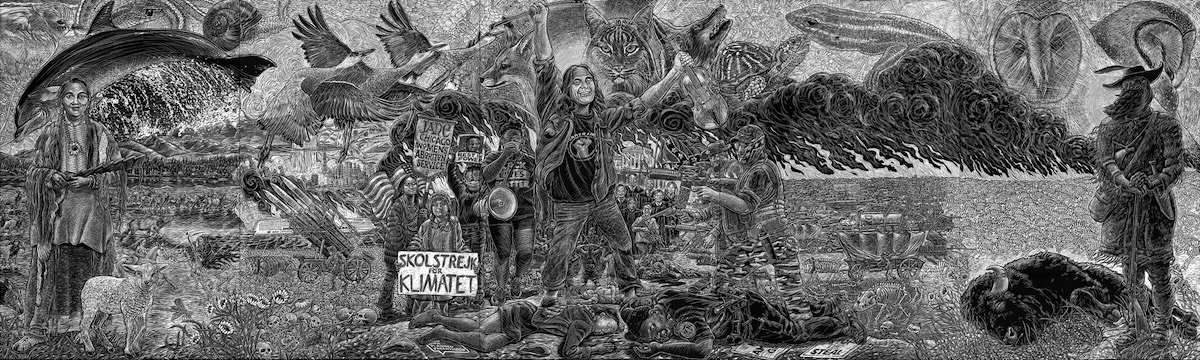
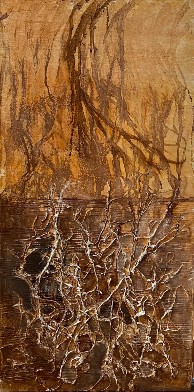
Tragic Prelude, Tribute to Judi Bari, 2023-2024, scratchboard, 36” x 120”
Jos Sances (he/him) has made his living as a Printmaker and Muralist for more than 45 years in the San Francisco Bay Area. He founded Alliance Graphics, a successful union screenprint shop, and earlier co-founded Mission Gráfica at the Mission Cultural Center for Latino Arts. The Library of Congress acquired 495 of his prints that represent this output. He has shown artwork in “Committed to Print” at the Museum of Modern Art in NYC and “¡Printing the Revolution! The Rise and Impact of Chicano Graphics 1965 to Now,” at the Smithsonian American Art Museum.
Artist statement
In 2023, while visiting Kansas, I saw John Steuart Curry’s mural “Tragic Prelude” at the State Capitol. It depicts John Brown in full-blown abolitionist rage. Completed in 1942, the mural is known for its revolutionary power
and urgent advocacy. The political divsions of the Civil War resonate today, as do the issues that divide the country now. John Brown’s figure in my artwork has been replaced by Judi Bari; both of them are martyrs to a cause: Brown’s cause, slavery; Bari’s cause, to save the environment. The political/social divisions today mirror those of the mid-19th Century.
Curry’s “Settler Plainsman” with his belief that the buffalo herds were endless, spoke to me. I couldn’t miss the raging prairie fire and huge tornado, central to one of Curry’s panels. Did he envision climatic conditions getting much worse? Could he have imagined the mass extinction of so many species? I depicted some of those extinct creatures in the sky–four of them from the Bay Area.
The final panel here gives a glimmer of hope — a vision of native wisdom that has survived for thousands of years. It endures in spite of the onslaught of predatory extraction and capitalist greed.

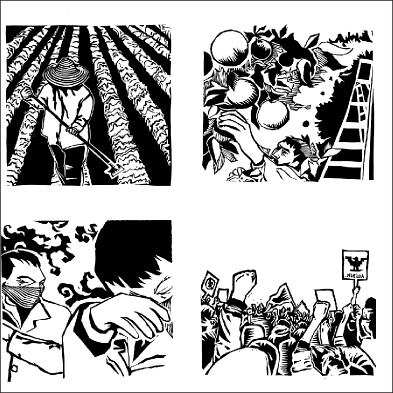
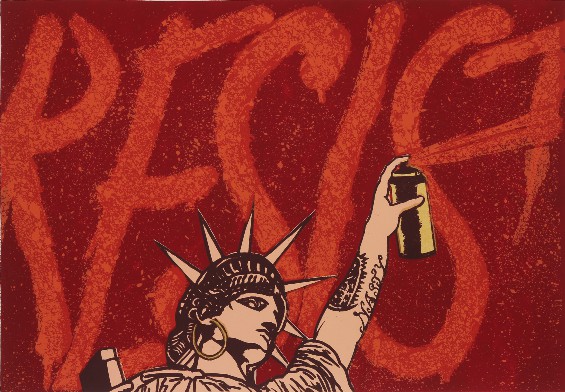
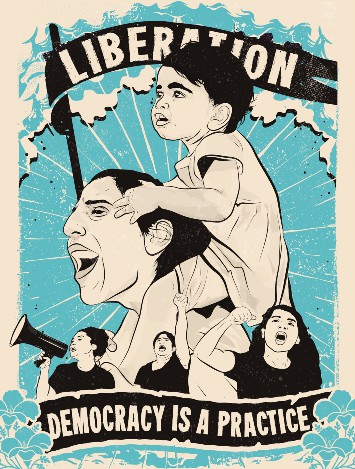
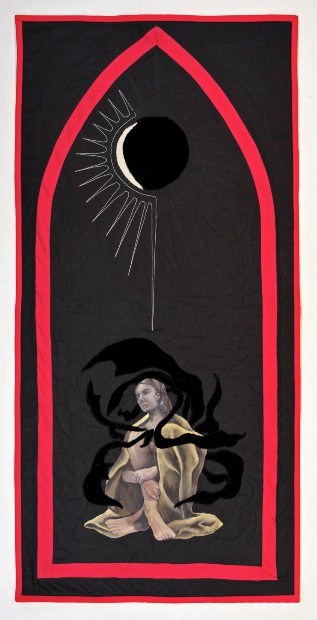
Nasty Liberty, 2017, screenprint, 17” x 203/4”
Ester Hernandez (she/her) was born in California’s San Joaquin Valley to a Mexican/Yaqui farm worker family. The UC Berkeley graduate is an internationally acclaimed San Francisco-based visual artist. She is best known for her depiction of Latina/Native women through her pastels, prints, and installations. Her work reflects social, political, ecological, and spiritual themes.
Hernandez has exhibited her work in numerous national and international solo and group shows. Among others, her work is included in the permanent collections of the National Museum of American Art, Smithsonian; the Library of Congress; New York’s Museum of Modern Art (MoMA); Museo Casa Estudio Diego Rivera y Frida Kahlo in Mexico City; and the Victoria and Albert Museum in London. Her artistic and personal archives are housed at Stanford University.
Artist statement
“Nasty Liberty” is a call to action that is inspired by the right-wing regime’s new era of horrific backward thinking that is attempting to destroy civil and human rights, science, equality, etc. Viva La Libertad!

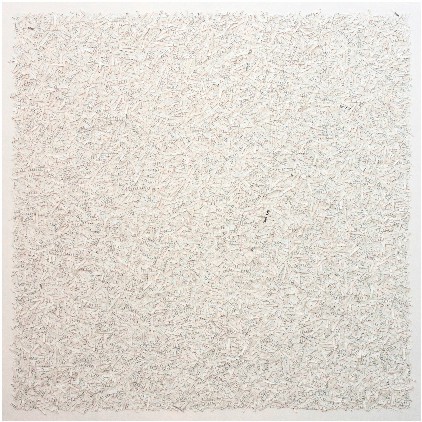
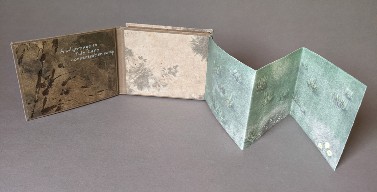
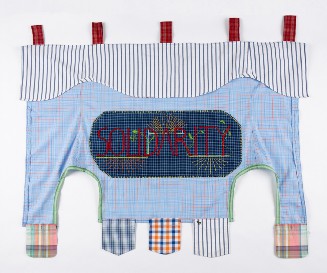
Garment Worker Solidarity Banner, 2023, parts of used clothing,
embroidery floss, thread, and wooden dowel, 36” x 46”
Rachel Breen’s (she/her) work has been shown widely across the country and internationally, including a solo exhibition at the Minneapolis Institute of Art and recently, in the 15th Bienal De La Habana in Havana, Cuba. She was awarded a Fulbright-Nehru Senior Scholar research fellowship in India. Breen has also been awarded residencies at Mac- Dowell, Willapa Bay AiR, and the Virginia Center for Creative Arts. She is a recipient of a McKnight Fellowship for Visual Artists, an inaugural recipient of the Jerome Hill Artist Fellowship, and has received five Minnesota State Arts Board grants. Breen holds a master of fine arts degree from the University of Minnesota and a bachelor’s degree from The Evergreen State College. She lives in Minneapolis, Minn., where she maintains an active studio practice. Breen is a tenured professor of art at Anoka Ramsey Community College and currently serves as the chair of the Department of Visual Arts.
Artist statement
Through acts of dismantling and remaking, I divert sewing’s original purpose, that of creating and mending, toward a critique of the global fashion industry, its impact on labor rights, and a reimagining of a garment system that is just and sustainable. Massive overproduction and overconsumption of clothing today are responsible for exploiting workers and fueling climate change, contributing to as much as 10 percent of global carbon dioxide emissions.
This banner is part of a series of textile assemblages where I take apart used clothes and reassemble them into reimagined banners, flags, and collective garments. The clothing parts reveal the labor that went into the making of our clothes. Used clothes embed a range of histories into the banners — those of both workers and wearers raising essential questions about how garments are made and discarded and their impact on the climate.
My banner is inspired by banners made in the early 1900s by the International Ladies Garment Workers Union. Today the banner conveys alarm about unfair working conditions, declares warning about our climate crisis, and speaks of the urgent need for resistance today. It aims to make visible the politics of the clothes we wear, demonstrate our capacity to reinvent mutual systems of exchange, resist exploitation, and express solidarity with garment workers around the world.
My work creates spaces for cultivating deeper understandings of solidarity and collective power. My interest in labor rights stems from histories of Jewish activism in the garment industry, my family history as immigrants and activists, and the role of the sewing machine in these stories.

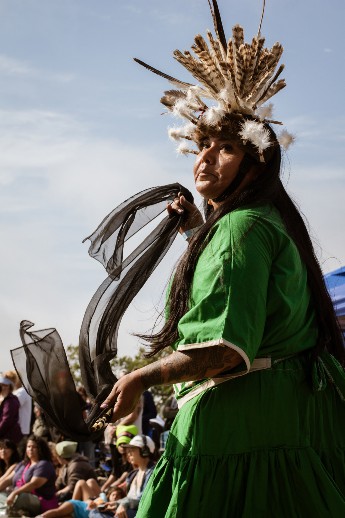
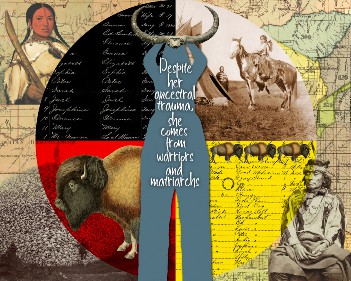
Healing Her Ancestors, 2022, photographic print, 16” x 20”
Roxann Murray (she/her) is an award-winning neurodivergent photographer based in Tacoma, Wash. She specializes in documenting community, nature, and intentional travel. She received her Bachelor of Arts in Interdisciplinary Arts and Sciences with a concentration in arts, media, and culture from University of Washington Tacoma. A known biophiliac, Murray has had a strong connection with the natural world since she was a child. Growing up in the Pacific Northwest, she developed an affection for wildlife, trees, ferns, and the seashore. The majority of her photographs focus on pattern and color. Her photos of people and community are candid shots.
Artist statement
Nakota and Dakota on her father’s side, Murray tries to view the world through a decolonized perspective and live in a way that she hopes make her ancestors proud. “Matriarch,” her latest body of work, was funded by the Tacoma Arts Commission through the Artists Initiative Program.
I have always been a fighter since I was a child because no one fought for me. I fight for my rights, my voice, and my survival. I fight for others who don‘t have a voice through the lens of a camera, through visual storytelling. I document others’ struggles so people can understand the world from a different perspective; becoming desensitized to issues affecting the planet and her inhabitants will bring nothing but harm to all of us, and sadly, apathy has spread.
I have a tumultuous relationship with the word “resilient,” as do many people with Indigenous descent. We have had to survive colonization, genocide, and erasure since 1492, which makes our ancestral trauma a huge burden. That trauma, along with modern life events, shows up in physical and health issues. Frankly, we are sick and tired of being called resilient. We know that society wants us to stop fighting, but we will never do that. We will continue to survive; we have for over 500 years.
I am the daughter of an abusive family, a progeny of both the colonizer and the colonized. I get my resilience from my matriarch ancestors; they stand beside me as I walk this Earth and they protect me when I am afraid.
Low-income, neurodivergent, disabled Indigenous artists are not prioritized. In a world where billionaires and narcissists are celebrated, sensitive, empathic people with no money and weak health are ignored. I am a fighter living in a world where society wants people like me to disappear.

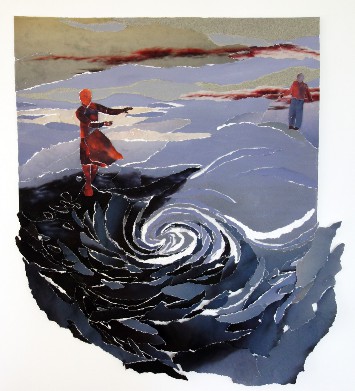
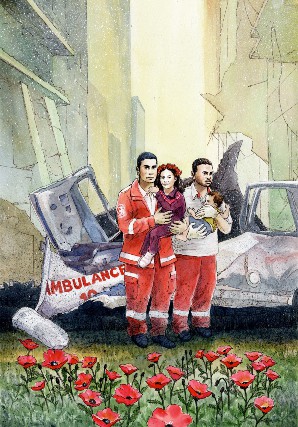
Yousef, Ahmed, and Hind, 2025, watercolor, gouache, and ink on hot-press watercolor paper, 181/4” x 121/2”
Fernando Martí (he/him/el) is a printmaker, writer, community architect, and housing activist, based in San Francisco, Calif., Ramaytush Ohlone land. His work reflects his training in urbanism, his roots in rural Ecuador, and his experience of migration and residence in the heart of Empire. His poetry, prints, altar ofrendas, and public constructions inhabit the space between ancestral traditions with Latinx roots and a futurist imagination. With a childhood fascination with comic books, science fiction, and the future, and informed by magical realism, Fernando’s imagery often juxtaposes present conditions with utopian imaginations of possibility and transformation. The subjects of his artwork grow from a process of reclaiming and re-envisioning culture in diaspora and in a context of climate change, engaged in the remaking of space. His artistic home is the political arts collective justseeds.org.
Artist statement
For “Resistance and Resilience,” I created a painting honoring Palestinian paramedics Yousef Zeino and Ahmed al Mahdoun.
Nothing has horrified and inspired me more than Gaza; the beauty and courage and creativity and humor of people facing this horror and trying to communicate this to the world. And by the incredible solidarity work of Palestinians, Arabs, Anti-Zionist Jews, health care workers for Palestine, artists and writers for Palestine, working together for a durable peace with justice. Don’t look away. Don’t stop talking about Gaza.
The painting depicts the two Red Crescent Society paramedics, Yousef Zeino and Ahmed al Mahdoun, who, after receiving clearance from the Israeli military in February 2024, rushed to rescue six-year-old Hind Rajab, trapped for twelve days in a bullet-ridden car in Gaza City with her the bodies of her uncle, aunt, and four cousins, killed by Israeli forces. When the paramedics were within sight of Hind’s car, an Israeli tank targeted the ambulance, killing both Yousef and Ahmed. Hind’s mother and father survived because they could not fit in the car and left the Israeli-imposed ”evacuation zone” on foot.
I imagine Yousef and Ahmed in the afterlife, holding Hind and another child, carrying out their sacred duty for life. Dedicated to all creation’s children in the land of Palestine, that they may all someday know peace, liberation, and kinship.